
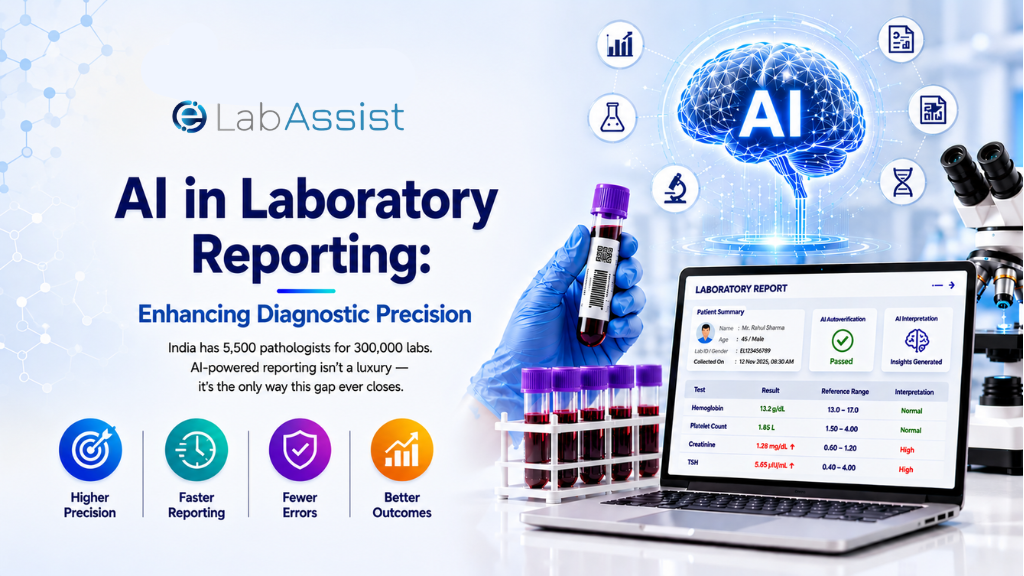
AI in Laboratory Reporting: Enhancing Diagnostic Precision
June 4, 2026
The Reporting Crisis in India’s Diagnostic Labs
Think about what happens at a busy diagnostic lab on a Monday morning. Samples are pouring in from home collection, walk-in patients, and hospital referrals. Each one needs to be processed, analysed, validated, and reported. The results need to be accurate, released quickly, and delivered to the right person in the right format.
Now do that 500 times before noon, with a team that includes two overworked technicians, one junior doctor reviewing results, and a senior pathologist who hasn’t had a break since 7am.
This is the daily reality in thousands of Indian diagnostic labs. And it’s why errors happen. Not because people aren’t trying hard enough but because the system is built on humans doing things that humans are not reliably good at under pressure: manual data entry, visual pattern matching across hundreds of results, remembering to check one patient’s result against their history from three months ago.
The good news is that the solution is not to hire more pathologists India simply doesn’t have enough, and training takes years. The solution is AI-powered laboratory reporting: systems that automate the routine, augment the complex, and free the human expert to do what only a human can do.
What AI Lab Reporting Actually Means
When people hear “AI in lab reporting,” many picture a robot replacing the pathologist. That’s not what’s happening and it’s not what Indian labs need right now.
What AI lab reporting actually means is this: every repetitive, rule-checkable step in the reporting process is handled by the machine, so the human expert only engages where human judgement is genuinely needed.
In a modern LIMS with AI-powered reporting, the system handles result capture from instruments automatically, applies reference ranges by age and gender, checks each result against the patient’s history, flags anything that looks unusual, writes basic interpretive comments for common findings, routes complex cases to the right specialist, and delivers the final report to the patient or clinician before they’ve even had to ask.
The pathologist still exists. They’re still crucial. But instead of spending six hours reviewing 400 normal CBC results, they spend six hours on the 40 cases that actually need their expertise the abnormal lymphocytes, the unexpected critical values, the pattern that doesn’t quite fit the clinical picture. That’s a better use of everyone’s time, including the patient’s.
How AI Powers Each Stage of the Lab Reporting Workflow
AI doesn’t drop into a single step of reporting it improves the entire chain. Here’s what an AI-assisted reporting workflow looks like from start to finish in a LIMS-integrated lab.
- Instrument result capture zero manual transcription
When an analyser completes a test, the result transfers directly into the LIMS via bidirectional HL7 or ASTM interface. There is no manual typing of result values which eliminates the most common source of transcription errors in busy labs. The AI already has the number, the quality control status, and the instrument flag before a human has looked at the result.
Bidirectional instrument interface
- Intelligent reference range application
Unlike a static printed reference range, the AI applies age-specific, gender-specific, and sometimes population-specific reference intervals. A haemoglobin of 11.5 g/dL means something completely different in an adult male, a pregnant woman, and a six-month-old infant. The AI knows the difference and flags accordingly automatically, without the technician having to look it up.
Age & gender-adjusted ranges
- Delta check catching errors that reference ranges miss
One of the most powerful AI reporting checks is the delta check: comparing the current result against the same patient’s previous result and flagging statistically improbable changes. A creatinine that jumps from 0.9 to 4.2 in 48 hours either means acute kidney injury or a sample mix-up. The AI surfaces this immediately for review, rather than letting a potentially wrong result reach the clinician.
Delta check & historical comparison
- Autoverification releasing routine results without manual sign-off
For results that pass all checks reference range, delta check, QC status, critical value screening the AI engine releases the result automatically. No pathologist needs to look at it. In high-volume labs, this covers 60–80% of routine results. The other 20–40% that flag for human review are the ones where expert input genuinely matters. Studies show autoverification systems can reduce validation time by hundreds of hours while achieving 94%+ rule correctness rates.
Autoverification — 60–80% auto-release rate
- NLP interpretive comment generation
For common, well-understood findings, Natural Language Processing generates the interpretive comment on the report automatically. “Mild microcytic anaemia consider iron deficiency or thalassaemia trait” doesn’t need a pathologist to write it from scratch every time. The AI generates it based on the result pattern, and the pathologist reviews and confirms. This saves hours of repetitive typing while maintaining clinical quality in the final report.
NLP interpretive comments
- Critical value notification and report delivery
When a critical value is detected a potassium of 6.8 mmol/L, a platelet count of 8,000, a glucose of 28 mmol/L the AI instantly notifies the requesting clinician via SMS and the LIMS dashboard, and flags the result for urgent pathologist review. After validation, the report is automatically delivered to the patient via WhatsApp, the clinician’s EMR, or the patient portal with no manual dispatch step required.
Auto delivery via WhatsApp / SMS / EMR
6 AI Features That Transform Lab Report Quality
Not all AI in lab reporting is the same. Here are the six specific capabilities that separate a genuinely AI-powered reporting system from a LIMS that just uses the word “AI” in its marketing.
- Autoverification engine
Rule-based + ML validation that releases routine results automatically. Configurable rule sets for each test type, instrument, and patient demographic. Full audit trail for every autoverified result.
Reduces pathologist workload 60–80%
- AI delta check system
Compares every result against the patient’s longitudinal history. Flags changes that are statistically impossible for biological variation exposing sample swaps and specimen mix-ups before they reach the report.
Catches errors reference ranges miss
- NLP report comment generation
Natural Language Processing generates clinically appropriate interpretive text for common result patterns iron deficiency anaemia, diabetic nephropathy profile, thyroid disorder patterns. Pathologist reviews and approves; AI does the typing.
Hours of reporting time saved daily
- Critical value intelligence
Instant SMS + dashboard alert to requesting clinician when a result breaches critical thresholds. AI escalates appropriately a critically low platelet goes to haematology, a critically high troponin goes to cardiology.
Zero missed critical values
- Pattern recognition flags
AI identifies result patterns that suggest specific conditions the combination of elevated LFTs + low albumin + prolonged PT that suggests cirrhosis, even when each individual result is only mildly abnormal. These subtle patterns are exactly what gets missed at 2pm on a Friday afternoon.
Catches what humans miss under fatigue
- Automated report dispatch
Once validated, reports are automatically dispatched to patients via WhatsApp, SMS, email, or patient portal and to referring doctors via EMR integration or digital portal. No manual download, no printing, no human dispatch step.
From validation to patient in seconds
Traditional Reporting vs AI Lab Reporting: What Really Changes
This comparison is not about technology for its own sake. It’s about what a lab actually looks like at 4pm on a Tuesday — and whether the team is drowning or in control.
|
Reporting Stage |
❌ Traditional (Manual) |
✅ AI-Powered Reporting |
|
Result capture |
Manual transcription from analyser printout 0.1-1% transcription error rate |
Bidirectional HL7 interface zero transcription errors |
|
Reference range check |
Same printed range for all patients age/gender differences missed |
AI applies age, gender, pregnancy-specific ranges automatically |
|
Historical comparison |
Manual technician must pull previous reports (rarely done) |
Automatic delta check on every result, every time |
|
Pathologist review burden |
Every result reviewed manually unsustainable at scale |
60–80% auto-released; pathologist reviews only flagged cases |
|
Interpretive comments |
Written from scratch each time inconsistent quality, time-consuming |
NLP generates standardised, clinically accurate comments for review |
|
Critical value handling |
Discovered during manual review delay risk for life-threatening values |
Instant SMS alert the moment the critical result enters the system |
|
TAT for routine results |
Hours bottlenecked by manual review queue |
Minutes for autoverified results; same-day for all others |
|
Report delivery |
Manual PDF dispatch or patient collection required |
Automatic delivery via WhatsApp/SMS/email on validation |
|
Audit trail |
Paper records incomplete, manipulable, hard to retrieve |
Complete digital log of every validation step, every flag, every decision |
|
NABL compliance |
Manual documentation preparation weeks of effort before audit |
Auto-generated ISO 15189 audit trail always current, one-click export |
NLP in Lab Reports: When AI Writes the Interpretive Comments
One of the most tangible and most human applications of AI in lab reporting is Natural Language Processing for interpretive comment generation. And it’s worth spending a moment understanding exactly what this means, because it’s often misunderstood.
The AI is not diagnosing the patient. It is not replacing the pathologist’s clinical judgement. What it is doing is automating the writing of the comment the text that translates a set of numbers into clinically useful language for the referring doctor.
Take a common CBC result: haemoglobin 9.8 g/dL, MCV 65 fL, MCH 19 pg, serum ferritin 4 ng/mL. An experienced pathologist knows immediately what this means and could write the comment in their sleep: “Microcytic hypochromic anaemia consistent with iron deficiency. Clinical correlation and iron studies recommended.” The NLP engine has learned from thousands of such comments and can write the same thing accurately, consistently, in under a second.
Now multiply that by 400 CBCs a day. The pathologist’s job is no longer to type the same sentence 400 times. Their job is to review the 12 CBCs where the pattern is unusual the one where the microcytosis doesn’t fit the iron studies, or the one where the red cell morphology suggests something the algorithm flagged but couldn’t quite name.
Important transparency note: Every AI-generated interpretive comment in a quality system should be reviewed and approved by a qualified pathologist before release it should be clearly marked as AI-assisted in the report audit trail. This is both best practice and an ISO 15189:2022 requirement for documented result verification. AI generates; human validates.
AI Reporting and NABL Accreditation: What Compliance Looks Like
If you’re a lab owner thinking about implementing AI-powered reporting, one of your first questions is almost certainly: Will NABL accept this?
The short answer is yes when it’s done correctly. The longer answer is that AI reporting, implemented within a properly configured LIMS, not only satisfies NABL accreditation requirements but makes them significantly easier to demonstrate during an audit.
Here’s what ISO 15189:2022 requires in the areas AI reporting directly supports:
- Clause 5.8 – Reporting of results: Requires that results are accurate, legible, unambiguous, and include the laboratory’s interpretation. AI-generated NLP comments directly satisfy the interpretation requirement, provided they are reviewed by a qualified professional before release.
- Clause 5.9 – Release of results: Requires documented criteria for result release which is exactly what an autoverification rule set provides. NABL assessors accept autoverification systems when the lab can produce documented rule validation records.
- Clause 6.4 – Equipment: Requires documented evidence of instrument calibration and QC performance. AI-driven QC monitoring logs this continuously and automatically.
- Clause 8.7 – Nonconforming work: When AI flags an error before release, that flag and the subsequent action are logged in the LIMS creating the documented corrective action record NABL requires.
For labs preparing for NABL assessment: An AI-powered reporting system with full audit trails is genuinely easier to demonstrate compliance with than a manual system. The assessor can see every result, every flag, every validation decision, and every delivery event timestamped, user-linked, and exportable in seconds. Manual labs often spend weeks reconstructing this documentation before an audit.
AI Lab Reporting in India: Where Things Stand in 2026
India’s relationship with AI in diagnostics is accelerating faster than most people in the industry realise. It is no longer theoretical.
An AI system deployed across 17 major healthcare systems in India including diagnostic centres, large hospitals, and government hospitals processed over 150,000 chest X-ray scans and achieved 99.8% precision for normal vs abnormal classification, reducing reporting times by up to 50%. This is not a pilot study. This is a functioning system, running at scale, today.
India’s AI in medical diagnostics market is set to triple in size between 2025 and 2030, driven by a combination of factors that are uniquely Indian: the sheer scale of diagnostic demand from a 1.4 billion population, the acute shortage of specialist pathologists and radiologists, and a diagnostic lab ecosystem of over 100,000 labs that is highly fragmented and in urgent need of standardisation.
The labs that move first that implement AI-powered reporting now, build the data infrastructure, and train their teams will be the labs that dominate their markets in 2028 and 2030. The labs that wait will find themselves behind both on quality metrics and on accreditation requirements, as NABL’s standards continue to evolve toward digital-first expectations.
Frequently Asked Questions
- How does AI improve laboratory reporting accuracy?
AI improves accuracy through autoverification (flagging abnormal results before release), delta checks (comparing results against a patient’s history to catch specimen errors), critical value alerts, and NLP-generated interpretive comments. Together these eliminate manual transcription errors, catch specimen mix-ups, and prevent the reporting delays caused by routine manual review of results that don’t need it.
- What is AI autoverification in pathology labs?
AI autoverification is an engine that automatically reviews completed results against a configured rule set reference ranges, delta checks, QC flags, critical value thresholds — and releases routine results without requiring pathologist intervention. Only results that fall outside defined parameters are sent for human review. In high-volume labs, this covers 60–80% of routine results, freeing pathologists for complex and critical cases.
- Can AI generate lab reports automatically in Indian diagnostic labs?
Yes. Modern LIMS platforms with AI integration can auto-generate reports once results are validated, populate interpretive comments using NLP, apply age and gender-adjusted reference ranges, flag critical values, and deliver reports automatically via WhatsApp, SMS, or email. An AI system deployed in 17 Indian healthcare systems reduced reporting times by up to 50% while maintaining 99.8% precision for normal vs abnormal classification.
- Is AI lab reporting compliant with NABL accreditation in India?
Yes, when implemented correctly. ISO 15189:2022 (the NABL standard) requires documented result verification procedures. AI autoverification satisfies Clause 5.8 and 5.9 when the rule sets are validated and documented. NABL assessors accept AI-driven autoverification systems provided the lab maintains rule validation records, a complete audit trail, and documented override procedures all of which eLabAssist LIMS generates automatically.
- What is the difference between AI lab reporting and traditional lab reporting?
Traditional lab reporting relies on manual result entry, pathologist review of every result, handwritten interpretive comments, and manual report dispatch. AI lab reporting automates result capture via HL7 interface, applies intelligent validation rules instantly, generates NLP interpretive comments, flags anomalies before release, and delivers final reports automatically. The result is faster TAT, fewer errors, and pathologist time redirected from routine reviewing to complex diagnostics.
- How does AI reduce diagnostic errors in lab reports?
AI reduces diagnostic errors by eliminating manual transcription (bidirectional instrument interface), catching specimen misidentification through delta checks, applying population-specific reference ranges, flagging results inconsistent with a patient’s clinical history, and using pattern recognition to identify analytical errors that humans miss under workload pressure. Labs using traditional manual systems report 40% higher error rates compared to those using integrated digital pathology workflows.
Conclusion: AI in Lab Reporting Is Not the Future — It Is the Standard
The labs that are thriving in India’s competitive diagnostic market in 2026 share a common characteristic: they have stopped treating their pathologists as data entry clerks and started treating them as the clinical experts they trained for years to become.
AI-powered laboratory reporting autoverification, delta checks, NLP interpretive comments, critical value intelligence, and automated report delivery is what makes that shift possible. It takes the routine, the repetitive, and the rule-checkable off the human’s plate, and redirects human expertise to the cases that actually benefit from it.
The numbers support this. A 50% reduction in reporting time. A 40% lower error rate versus manual workflows. A 26% annual growth rate in the AI pathology market that tells you where the industry is heading. And an India-specific context 5,500 pathologists for 300,000 labs that makes AI not a nice-to-have but a clinical necessity.
eLabAssist LIMS brings AI-powered reporting to diagnostic labs of every size from a single-location pathology centre in Nashik to a 50-branch corporate chain across India and Africa. The autoverification engine, NLP reporting tools, and real-time critical value alerts are built in, configured to Indian reference ranges, and compliant with ISO 15189:2022 and ABDM standards from day one.