
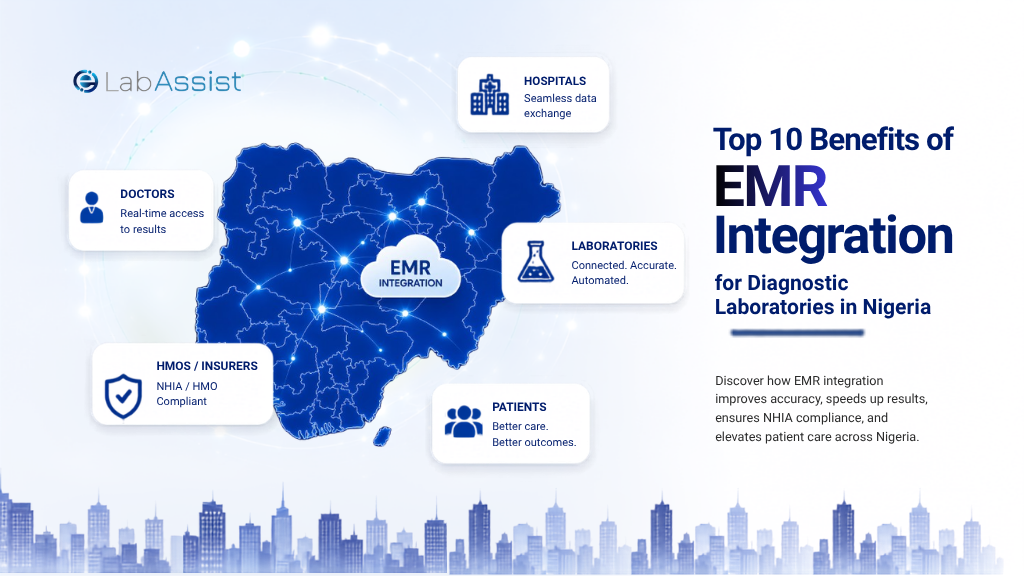
Top 10 Benefits of EMR Integration for Diagnostic Laboratories in Nigeria
June 26, 2026
Nigeria’s healthcare system is undergoing a rapid digital transformation. With over 220 million people, a growing network of hospitals, and increasing pressure from agencies like the National Health Insurance Authority (NHIA), diagnostic laboratories are no longer able to rely on manual workflows, paper reports, or disconnected software systems.
At the heart of this transformation lies one critical capability: EMR integration for diagnostic laboratories in Nigeria the seamless connection between a Laboratory Information Management System (LIMS) and Electronic Medical Records (EMR) platforms used by hospitals and clinics.
In this article, we explore the top 10 benefits of LIMS-EMR integration, what it means for Nigerian labs specifically, and how platforms like eLabAssist are making it a reality across the country.
What Is EMR Integration for Diagnostic Labs?
EMR integration refers to the bidirectional data exchange between a diagnostic lab’s LIMS and a hospital or clinic’s Electronic Medical Record (EMR) or Hospital Information System (HIS). Using standards like HL7 FHIR and ASTM, this integration allows:
- Doctor’s test orders to flow automatically into the lab
- Lab results to reflect instantly inside the patient’s EMR
- Billing data to sync with the hospital’s finance module
- Patient demographics to be shared without re-entry
In Nigeria, where many labs still operate on manual or semi-digital workflows, this integration is a game-changer reducing errors, saving time, and enabling a higher standard of patient care.
Top 10 Benefits of EMR Integration for Diagnostic Laboratories in Nigeria
1. Elimination of Manual Test Order Entry Errors
One of the most common causes of diagnostic error in Nigerian labs is manual transcription nurses or lab staff re-typing doctor’s orders from paper or verbal instruction into the lab system. This leads to wrong tests being run, incorrect patient names, or duplicate samples.
With LIMS-EMR integration, test orders placed by the doctor directly in the hospital’s EMR are auto-transmitted to the lab queue with zero manual entry. Patient name, age, gender, doctor ID, ward, and requested tests are all transferred accurately.
Impact: Studies across Sub-Saharan Africa show manual transcription errors contribute to up to 17% of diagnostic discrepancies. Integration virtually eliminates this category of risk.
2. Faster Turnaround Time (TAT) Across the Care Chain
Turnaround Time (TAT) the time from sample collection to result delivery is a critical KPI for any diagnostic lab. In Nigeria, poor TAT due to manual workflows is a common patient complaint and a key reason HMOs de-empanel labs.
EMR integration accelerates TAT at multiple points:
- Order-to-collection: Lab receives the order the moment the doctor places it
- Collection-to-processing: Barcoded samples are linked to the correct patient record automatically
- Result-to-doctor: Results appear in the doctor’s EMR as soon as they are validated no printing, scanning, or calling required
eLabAssist’s integrated LIMS platform reduces average TAT by 30–50% for connected hospital labs in Nigeria.
3. Real-Time Result Delivery to Clinicians
In traditional Nigerian hospital setups, a doctor may not see a lab result until hours after it’s ready because a physical report needs to be printed, stamped, and physically walked to the ward. In emergency medicine, this delay can be life-threatening.
With EMR integration:
- Critical and urgent results are auto-flagged and appear inside the doctor’s EMR in real time
- Critical value alerts (panic values) can trigger automatic SMS or in-app notifications to the treating physician
- Results are accessible across departments the cardiologist, nephrologist, and GP all see the same record simultaneously
This is particularly valuable in Nigerian teaching hospitals (UCH Ibadan, LUTH Lagos, ABUTH Zaria) and large private hospitals managing multi-specialty patients.
4. Accurate NHIA/HMO Billing and Claims Management
One of the most significant operational headaches for diagnostic labs in Nigeria is HMO and NHIA billing. Incorrect codes, missing authorisations, or mismatched tests lead to claim rejections directly impacting revenue.
LIMS-EMR integration solves this by:
- Pulling the correct HMO plan and coverage details from the patient’s EMR at the time of test ordering
- Auto-populating NHIA procedure codes on the billing module
- Flagging tests that require pre-authorisation before the sample is collected
- Reducing manual claim submission errors that result in delays or rejections
For labs participating in the NHIA’s Contributory Healthcare Management Initiative (CHMI), this is no longer optional it is an operational necessity.
5. Complete Patient History Visibility for Lab Scientists
When a lab scientist validates a result, context matters. A slightly elevated creatinine in a patient with known chronic kidney disease is very different from the same value in a healthy 25-year-old.
With EMR integration, lab staff can view (within access controls):
- Patient’s current diagnoses and comorbidities
- Current medications that may affect test interpretation
- Previous test history (delta checks are automated flagging results that deviate sharply from the patient’s baseline)
- Allergies and special notes from the clinical team
This clinical context dramatically improves autoverification accuracy and reduces unnecessary repeat testing.
6. Seamless Multi-Site and Hub-and-Spoke Operations
Nigeria has a growing number of hub-and-spoke diagnostic networks — large reference labs in Lagos, Abuja, or Port Harcourt that receive samples from smaller collection centres across the country.
eLabAssist’s cloud LIMS with EMR integration supports this model by:
- Allowing collection centres (spokes) to log patient demographics using the referring hospital’s EMR
- Transmitting test orders and results between sites in real time
- Giving hub labs full visibility into pending samples across all locations
- Enabling centralised billing while maintaining site-level reporting
For groups like diagnostic chains expanding across Lagos, Kano, Enugu, and Abuja, this is foundational to operational scalability.
7. Digital Quality Control and Audit Trail Compliance
Nigerian labs seeking or maintaining NABL accreditation or ISO 15189:2022 certification must demonstrate a complete and tamper-proof audit trail for every patient result — from order to validation to delivery.
With LIMS-EMR integration:
- Every action (order placed, sample collected, result entered, validated, reported) is timestamped and user-stamped automatically
- QC data is logged digitally alongside patient results
- Amendments or corrections to results are tracked with reasons
- The entire chain of custody is available for assessor review during accreditation visits
Manual log books and retrospective record reconstruction — common failure points during NABL audits — are completely eliminated.
8. WhatsApp and Digital Report Delivery to Patients
Nigeria has one of the highest WhatsApp penetration rates in Africa, making it a natural channel for patient communication. eLabAssist’s LIMS integrates with WhatsApp Business API and SMS gateways to deliver lab reports directly to patients — with link-based, branded PDF reports.
With EMR integration layered on top:
- Patient contact details (verified phone number and email) are pulled from the EMR at registration no re-entry
- Reports are auto-released after doctor validation
- Patients can access their complete result history via a patient portal, linked to their EMR record
This improves patient satisfaction scores and reduces front-desk queues for report collection a major pain point in busy Nigerian labs.
9. Reduced Operational Cost Through Workflow Automation
Every manual handoff in a diagnostic lab has a cost staff time, printing, courier, re-testing due to errors. EMR integration automates the most expensive of these handoffs:
Manual Task | Automated with EMR Integration |
Typing test orders from paper | Auto-received from EMR |
Printing and delivering results | Auto-pushed to EMR + WhatsApp |
Calling doctors about critical values | Auto-alert via EMR notification |
Manual HMO pre-auth checks | Auto-verified against plan database |
Duplicate patient registration | Single demographic source (EMR) |
For a mid-sized Nigerian lab processing 200–500 samples/day, these efficiencies translate to measurable reductions in staff overtime, error-related rework, and paper/printing costs.
10. Foundation for AI-Powered Diagnostic Intelligence
The most transformative long-term benefit of EMR integration is what it enables beyond today: AI-powered diagnostics. Machine learning models require large, structured, longitudinal datasets to deliver insights. Integration creates exactly that.
With a connected LIMS-EMR ecosystem, eLabAssist can deploy:
- AI Smart Reports – NLP-generated interpretive comments on lab results, contextualised to the patient’s clinical history
- Predictive flagging – identifying patients at risk of sepsis, AKI, or diabetic crisis based on lab trend analysis
- Population health dashboards – disease surveillance and outcome analysis for hospital administrators
- Anomaly detection – catching instrument drift or reagent lot issues before they reach patient reports
This positions Nigerian labs at the frontier of precision diagnostics — not just as sample processors, but as strategic clinical partners.
Why Nigerian Diagnostic Labs Cannot Afford to Wait
The Nigerian healthcare landscape is shifting fast:
- NHIA digital claims requirements are tightening
- Patients are demanding digital reports and faster service
- HMO panels are increasingly favouring accredited, tech-enabled labs
- Competition from Pan-African diagnostic chains is entering the market
Labs that invest in EMR integration today will build the operational foundation, accreditation readiness, and clinical credibility needed to win in this environment. Those that delay risk being left behind.
How eLabAssist Enables EMR Integration for Nigerian Labs
eLabAssist is a cloud-based LIMS/RIMS platform built specifically for diagnostic labs and healthcare institutions across India, Nigeria, South Africa, and 12+ countries. Our integration capabilities include:
- HL7 FHIR & ASTM industry-standard protocols for hospital connectivity
- Pre-built connectors for popular Nigerian HIS platforms and OpenMRS
- WhatsApp Business API integration for digital report delivery
- NHIA-compatible billing modules for claim management
- AI Smart Reports NLP-powered interpretive comments on patient results
- Cloud-first architecture accessible from any location, ideal for hub-and-spoke networks
- Offline-first mode for facilities with unreliable connectivity
With zero-downtime deployment and a dedicated onboarding team experienced in Nigeria’s healthcare environment, eLabAssist helps labs go live with full EMR integration in 4–6 weeks.
Frequently Asked Questions
Q: What is the difference between LIMS and EMR? A LIMS (Laboratory Information Management System) manages the internal workflow of a diagnostic lab sample tracking, result entry, QC, and reporting. An EMR (Electronic Medical Record) manages the clinical record of a patient within a hospital or clinic. EMR integration connects these two systems so data flows seamlessly between them.
Q: Is EMR integration expensive for small labs in Nigeria? With cloud-based platforms like eLabAssist, EMR integration is available on a monthly subscription model no large upfront hardware or IT investment. Integration costs depend on the complexity of the hospital system, but eLabAssist has pricing tiers suitable for independent labs and large hospital networks alike.
Q: Does eLabAssist support integration with Nigerian hospital HIS systems? Yes. eLabAssist supports integration with commonly used hospital information systems in Nigeria via HL7 FHIR APIs. Our team conducts a connectivity assessment during onboarding to map the specific integration requirements of your facility.
Q: Is patient data safe with cloud LIMS? eLabAssist is built on enterprise-grade cloud infrastructure with end-to-end encryption, role-based access control, and compliance with Nigeria’s NDPA 2023 (Nigeria Data Protection Act). Patient data is secure, backed up, and fully auditable.
Conclusion
EMR integration for diagnostic laboratories in Nigeria is no longer a luxury it is the operational backbone of a modern, competitive, and compliant diagnostic business. From eliminating manual errors and reducing TAT to enabling AI-powered clinical intelligence and NHIA billing compliance, the benefits are transformative at every level.
eLabAssist is helping Nigerian labs make this transition reliably, affordably, and with deep domain expertise in the local healthcare landscape.