
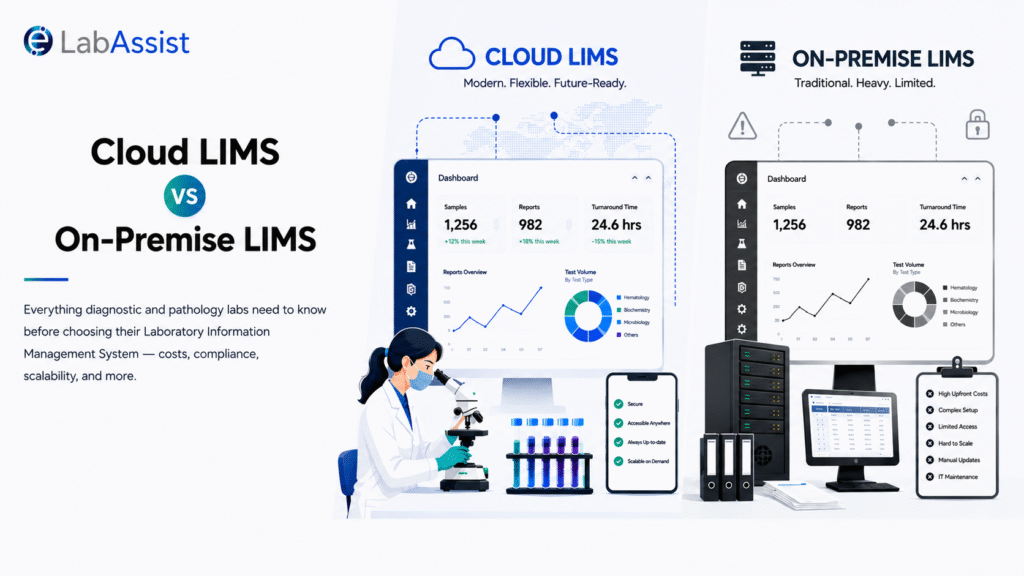
Cloud LIMS vs. On-Premise LIMS
May 22, 2026
What Is a LIMS and Why Does Deployment Type Matter?
A Laboratory Information Management System (LIMS) is the operational backbone of any modern diagnostic lab. It manages everything from sample registration, barcode tracking, instrument interfacing, and quality control to report generation and patient data management. Without a LIMS, labs are left juggling spreadsheets, paper logs, and manual errors, all of which cost time, money, and diagnostic accuracy.
But choosing a LIMS isn’t just about features. One of the most consequential decisions a lab owner or IT head will make is how the system is deployed: cloud LIMS (hosted on vendor-managed servers) or on-premise LIMS (installed on your own servers). This choice directly affects your upfront costs, data security posture, NABL and ABDM compliance burden, scalability, and long-term IT overhead.
In 2026, with diagnostic labs expanding across multiple branches, telehealth becoming mainstream, and regulators tightening data standards under the Digital Personal Data Protection (DPDP) Act, this decision has never carried more weight. This guide breaks down both options.
What Is Cloud LIMS?
A Cloud LIMS is hosted on remote servers managed by the software vendor (or a third-party cloud provider like AWS, Azure, or Google Cloud). Labs access the system via a web browser or mobile app, with no physical servers required on-site. Updates, backups, and security patches are handled automatically by the vendor.
Cloud LIMS is delivered using a Software-as-a-Service (SaaS) model — labs pay a monthly or annual subscription fee based on the number of users, sample volume, or modules used.
✓ Cloud LIMS Advantages
- Low upfront investment — no server hardware needed
- Access from anywhere — remote login for doctors and staff
- Automatic updates and security patches
- Scales instantly as your lab grows
- Built-in disaster recovery and data backup
- Faster implementation (days, not months)
- Vendor handles IT maintenance
- Ideal for multi-branch lab networks
✗ Cloud LIMS Limitations
- Requires stable internet connectivity
- Recurring subscription costs add up long-term
- Less control over data storage location
- Customization may be limited by vendor
- Dependent on vendor uptime and support
What Is On-Premise LIMS?
An On-Premise LIMS is installed and run on servers physically located within the lab or hospital premises. The organization owns the hardware, manages the software, and takes full responsibility for backups, security, updates, and IT infrastructure.
This model was the dominant deployment method for decades and is still preferred by some large hospital chains, government labs, and institutions with strict data sovereignty requirements.
✓ On-Premise Advantages
- Complete control over data and infrastructure
- Works without internet connectivity
- Highly configurable for complex workflows
- No recurring subscription, one-time license
- Preferred by government and defense labs
- Data stays within your physical premises
✗ On-Premise Limitations
- High upfront capital expenditure (servers, hardware)
- Requires dedicated in-house IT team
- Updates and patches are manual
- Difficult to scale for new branches
- Remote access is complex and costly to enable
- Risk of data loss if local backup fails
- Longer implementation timelines (3–6 months)
Head-to-Head Comparison
Here’s how Cloud LIMS and On-Premise LIMS stack up across the criteria that matter most to diagnostic lab operators in 2026.
|
Criteria |
☁ Cloud LIMS |
🖥 On-Premise LIMS |
|
Upfront Cost |
Low — subscription-based, no hardware |
High — servers, licenses, setup costs |
|
Ongoing Cost |
Monthly/annual SaaS fee |
IT salaries, maintenance, hardware refresh |
|
Implementation Time |
Days to weeks |
3–6 months or more |
|
Remote Access |
Full — any device, anywhere |
Limited — requires VPN or dedicated setup |
|
Scalability |
Instant — add users, branches, modules |
Requires hardware upgrades |
|
Data Control |
Vendor-managed |
Full in-house control |
|
Security |
Enterprise-grade, auto-patched |
Depends on internal IT capability |
|
Backup & Recovery |
Automated, off-site, continuous |
Manual, risk of local failure |
|
Internet Dependency |
Required for full functionality |
Works offline |
|
Customization |
Moderate — within vendor framework |
High — full control |
|
Compliance |
Pre-certified, vendor maintains compliance |
Lab IT team responsible |
|
Multi-Branch Support |
Native, centralized dashboard |
Complex, requires additional infrastructure |
|
Updates & Upgrades |
Automatic, included in subscription |
Manual, often costly |
|
Ideal For |
Growing labs, multi-branch, Africa & India expansion |
Large hospitals, government labs, data sovereignty mandates |
True Cost of Ownership: The Numbers Labs Often Miss
Most lab owners compare the sticker price of LIMS software and stop there. But the Total Cost of Ownership (TCO) tells a very different story — especially when you factor in on-premise’s hidden expenses.
On-Premise: Hidden Costs That Add Up
A typical on-premise deployment for a mid-size diagnostic lab involves significant hidden expenditure beyond the software license:
- Server hardware and rack infrastructure: ₹3–8 lakhs
- Dedicated IT administrator salary: ₹5–10 lakhs/year
- Annual hardware maintenance contracts: 15–20% of hardware cost
- Power and cooling for server room: ongoing
- Hardware refresh every 4–5 years
- Manual backup systems and offsite storage
- VPN setup for remote access: ₹1–2 lakhs
Cloud LIMS: Predictable, Scalable Costs
Cloud LIMS flips the cost model. Instead of capital expenditure (CapEx), you pay operational expenditure (OpEx) — a predictable monthly or annual fee that covers software, infrastructure, updates, support, and security. There are no surprise hardware failures or emergency IT calls at 2am during reporting season.
Key Insight: When factoring in 5-year TCO including hardware, IT salaries, and maintenance, cloud LIMS typically costs 30–50% less for labs with 5 or more branches, while offering significantly better uptime and features.
Compliance & Data Security: What Labs Must Prioritize
Data security in diagnostic labs is not optional — it’s regulated. Patient health data is among the most sensitive information that exists, and labs must comply with frameworks including ABDM (Ayushman Bharat Digital Mission) in India, ISO, NABL accreditation requirements, and increasingly the Digital Personal Data Protection (DPDP) Act, 2023.
Cloud LIMS & Compliance
Reputable cloud LIMS vendors like eLabAssist maintain compliance on behalf of their clients. This means the vendor holds ISO, ABDM certification, and audits, so when a lab is audited, they can produce the vendor’s compliance certificates. Updates to security standards are applied automatically. Data is encrypted in transit and at rest.
On-Premise & Compliance
With on-premise deployments, the compliance burden falls entirely on the lab’s internal IT team. They must ensure patch management, audit trails, access controls, and data encryption are correctly implemented and maintained. For small to mid-size labs, this is a significant operational risk, especially if the IT head leaves.
“eLabAssist is ABDM-certified, which means our clients automatically inherit that compliance posture — they don’t have to independently certify their data infrastructure.”
A Note on Data Sovereignty
Some labs — particularly government institutions or those handling sensitive genomic data, may have legal or policy mandates requiring data to remain on local servers. In these specific cases, on-premise or a private-cloud hybrid may be the only compliant option. For the vast majority of private diagnostic labs, however, a certified cloud vendor meets or exceeds in-house security capabilities.
Scalability, Remote Access & Multi-Branch Operations
The diagnostic industry is consolidating fast. Independent labs are acquiring affiliations, franchise models are expanding into tier-2 cities, and lab chains are entering African markets. In this environment, your LIMS must scale with your ambitions — not hold them back.
Cloud LIMS: Built for Growth
Cloud LIMS makes multi-branch management straightforward. A central dashboard gives ownership visibility across all locations in real time — sample status, revenue, quality control flags, and staff activity — regardless of whether branches are in Pune, Nairobi, or Lagos. Adding a new branch means provisioning new user accounts, not deploying new servers.
Remote access is a core feature, not an add-on. Lab owners, consulting pathologists, and corporate clients can log in from any device to view reports, track KPIs, or approve critical results — eliminating delays caused by physical distance.
On-Premise: The Scalability Ceiling
Every new branch on an on-premise system requires either a separate server installation (creating data silos) or expensive WAN infrastructure to connect to a central server. Remote access requires VPN configurations, which introduce security risks and require ongoing IT maintenance. As labs grow, these limitations become increasingly expensive to work around.
Which LIMS Deployment Is Right for Your Lab?
☁ Choose Cloud LIMS if you are…
- A growing independent or franchise lab
- Operating across multiple branches or cities
- Expanding into Africa or new Indian states
- A startup lab wanting fast go-live
- A lab without a dedicated IT team
- Focused on mobile access and WhatsApp reports
- Prioritizing ABDM or NABL compliance
- Looking to reduce capital expenditure
🖥 Consider On-Premise if you are…
- A large government or defense-affiliated lab
- Required by law to store data locally
- Running highly specialized research workflows
- In a location with no reliable internet
- An institution with a large in-house IT team
- Handling classified or genomic datasets
Conclusion: The Diagnostic Lab Industry Has Moved to Cloud — Here’s Why
The debate between Cloud LIMS and On-Premise LIMS isn’t as balanced in 2026 as it once was. For the overwhelming majority of diagnostic labs, particularly growing private labs, pathology franchise networks, and labs operating in emerging markets like India and Africa, cloud LIMS delivers superior value across every meaningful dimension: lower total cost of ownership, faster deployment, built-in NABL and ABDM compliance, and effortless scalability.
On-premise LIMS still has a role for specific, niche institutional contexts, government labs with data sovereignty mandates, defense institutions, or facilities with zero internet access. But for labs that want to grow, modernise, and compete in an increasingly digital healthcare landscape, cloud is no longer the future, it’s the present standard.
The most important question isn’t cloud vs. on-premise. Which cloud LIMS vendor has the experience, certification, and industry depth to be a long-term technology partner for your lab?
eLabAssist has been building LIMS for diagnostic labs since 2013. With over 1,500+ labs across 16+ countries, ABDM certification, ISO alignment, and deep expertise in African and Indian healthcare workflows, eLabAssist is designed for exactly the compliance and scalability challenges your lab faces today and tomorrow.
Frequently Asked Questions: Cloud LIMS vs On-Premise LIMS
What is the main difference between cloud LIMS and on-premise LIMS?
Cloud LIMS is hosted on vendor-managed remote servers and accessed through a web browser or mobile app — no on-site hardware is needed. On-premise LIMS is installed on servers physically located at the lab, giving full infrastructure control but requiring a dedicated IT team, server hardware investment, and manual maintenance.
Is cloud LIMS compliant with NABL and ABDM requirements in India?
Yes. Certified cloud LIMS vendors like eLabAssist maintain ABDM certification, NABL alignment, and audits on behalf of their clients. This means labs automatically inherit the vendor’s compliance posture without needing to independently certify their own data infrastructure.
Is cloud LIMS cheaper than on-premise LIMS?
Over a 5-year period, cloud LIMS is typically 30–50% cheaper for labs with 5 or more branches when accounting for total cost of ownership (TCO) — including server hardware, dedicated IT salaries, hardware maintenance, and periodic refresh cycles that on-premise deployments require.
Can cloud LIMS support multi-branch diagnostic labs?
Yes — multi-branch support is a core cloud LIMS strength. A centralised dashboard gives real-time visibility across all locations (sample status, revenue, QC flags) regardless of whether branches are in Pune, Nairobi, or Lagos. Adding a new branch requires provisioning user accounts, not deploying servers.
What happens to patient data security with a cloud LIMS?
Reputable cloud LIMS vendors encrypt all patient data in transit and at rest, maintain automated off-site backups, hold NABL and ISO certifications, and apply security patches automatically. This typically exceeds the security posture achievable by a small lab’s internal IT team.