
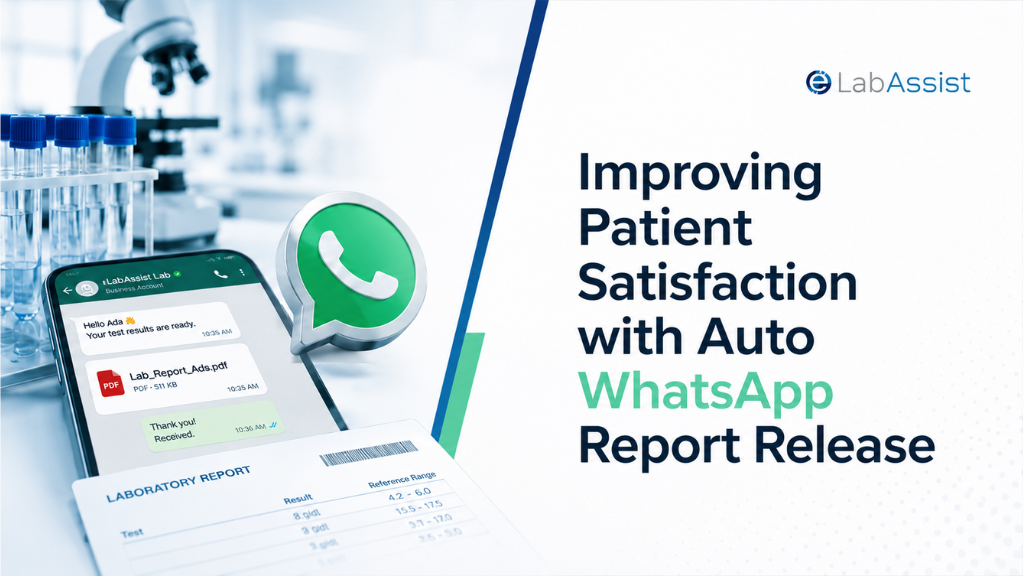
Patients don’t just want accurate reports anymore they want them fast, on a device they already check fifty times a day. That gap between “the report is ready” and “the patient actually has it in hand” is where most labs quietly lose patient trust. It shows up as long queues at the collection counter, front-desk phones ringing off the hook with “is my report ready?”, and one-star reviews that have nothing to do with the quality of care and everything to do with how badly the last mile of communication was handled.
eLabAssist closes that gap with Auto WhatsApp Release, a feature that sends lab reports, prescriptions, and status updates straight to a patient’s WhatsApp the moment they’re ready. No phone calls. No waiting at the front desk. No “please collect after 5 PM.”
In this article, we’ll go deep into what Auto WhatsApp Release actually does, the research and reasoning behind why it moves the needle on patient satisfaction, how it compares to older delivery methods, how it works inside eLabAssist step by step, what different types of practices notice after switching it on, and how to roll it out the right way.
The Problem: Why “Report Ready” Doesn’t Mean “Report Delivered”
Walk into almost any diagnostic lab or busy clinic and you’ll see the same pattern repeat itself. A report gets finalized in the back office, but it doesn’t actually reach the patient until someone prints it, someone calls to say it’s ready, or the patient physically shows up and asks at the counter. In the time between “ready” and “delivered,” several things tend to go wrong:
Patients call repeatedly to check status, tying up staff who could be helping people in front of them.
Reports get handed to the wrong person, or a family member picks up someone else’s paperwork by mistake.
Patients who live far away, are elderly, or are recovering from a procedure have to make an unnecessary second trip.
Reports sit printed and unclaimed for days, creating both privacy risk and clutter.
Referring doctors don’t get their copy in time to review before the patient’s follow-up visit.
None of these problems come from the quality of medical work. They come from the “last mile” the handoff between finishing the report and getting it into the patient’s hands. Auto WhatsApp Release is built specifically to close that last mile.
What Is Auto WhatsApp Release?
Auto WhatsApp Release is an eLabAssist feature that automatically delivers a patient’s report, result, or record on WhatsApp as soon as it’s finalized in the system with zero manual effort from your front-desk or lab staff. Instead of a technician printing a report and a receptionist calling ten patients an hour, the release happens the instant a report is verified and signed off inside eLabAssist.
Because it runs on WhatsApp, a platform most patients already have installed and check constantly there’s no new app to download, no portal password to remember, and no email inbox to dig through. The message simply arrives, exactly where the patient is already looking.
At its core, Auto WhatsApp Release turns report delivery from a manual, staff-dependent task into an automatic, system-triggered event. That single shift changes almost everything downstream about how patients experience your lab or clinic.
Why Patient Satisfaction Depends on Speed and Clarity
Most patient complaints in labs don’t come from clinical errors; they come from friction: long queues to collect a report, unclear instructions, missed calls, or reports that “should have been ready yesterday.” Patient satisfaction research consistently points to two factors: patients rank just below quality of care itself: how fast they get answers, and how clearly those answers are communicated.
Think about the emotional state of someone waiting on a lab report. They’re often anxious, sometimes about a serious health concern. Every extra hour of silence adds to that anxiety. When the report arrives the moment it’s ready, clearly formatted, from a verified source, on a familiar app that anxiety is replaced with a sense of being looked after. That feeling is the real driver behind higher satisfaction scores, better online reviews, and repeat visits.
Auto WhatsApp Release addresses both drivers directly. It removes the waiting-room bottleneck, and it delivers information in a format patients already trust and understand: no jargon-filled portal, no confusing login screen, just a message in the same app they use to talk to their family.
Auto WhatsApp Release vs. Traditional Report Delivery
Factor | Traditional Delivery (Print/Call/Email) | Auto WhatsApp Release |
Speed | Hours to days, depends on staff availability | Seconds after report is finalized |
Staff effort | High printing, calling, filing | None fully automated |
Patient effort | Must visit in person or check email/portal | Report arrives directly, no action needed |
Risk of misdelivery | Higher manual handoff, wrong printout | Lower tied to verified patient number |
Trust signal | Depends on tone of call or plain paper | Verified business profile, consistent branding |
Doctor visibility | Often delayed or missed | Can be copied to referring doctor automatically |
Audit trail | Manual logbooks, easy to lose | Automatically logged inside eLabAssist |
Patient experience | Passive, often stressful | Proactive, reassuring |
Seen side by side, it’s clear that the traditional model puts the burden of chasing information on the patient and the burden of manual delivery on the staff. Auto WhatsApp Release removes both burdens at once.
10 Ways Auto WhatsApp Release Improves Patient Satisfaction
1. Instant Report Delivery
The moment a report is approved in eLabAssist, it’s pushed to the patient’s WhatsApp often within seconds. Patients no longer need to call to ask “is it ready yet?”
2. No More Collection Queues
Elderly patients, working professionals, and out-of-town patients especially benefit from not having to make a second trip just to pick up paper. This is often the single biggest satisfaction in Labs report.
3. Reduced Front-Desk Load
Every report that goes out automatically is one less phone call, one less printout, and one less person waiting in line, freeing staff to focus on patients physically at the counter, who get faster, less rushed service as a result.
4. Fewer Errors From Manual Handling
Manual report handovers introduce risk: the wrong report handed to the wrong patient, misplaced printouts, or delayed handoffs between shifts. Automated release ties the report directly to the patient’s verified WhatsApp number, cutting that risk dramatically.
5. Built-In Trust and Transparency
Reports arrive from a verified business WhatsApp profile, so patients know the message is genuinely from your lab or clinic not a scam or spam text. This matters especially for sensitive results like biopsies, hormone panels, or infectious disease tests.
6. Better Experience for Repeat and Chronic Patients
Patients managing ongoing conditions who test regularly get a consistent, predictable experience every single visit, which builds long-term loyalty and reduces the mental load of managing their own care.
7. Faster Follow-Up Care
Because reports reach patients and, where relevant, their doctor faster, follow-up consultations and treatment decisions can happen sooner. This directly improves clinical outcomes, not just convenience.
8. Reduced Anxiety During the Wait
For results tied to serious diagnoses, every hour of silence adds stress. Immediate, automatic delivery shortens that anxious gap and signals that the clinic respects the patient’s time and peace of mind.
9. Stronger Word-of-Mouth and Online Reviews
Patients talk about experiences that surprise them positively. “I got my report on WhatsApp before I even left the building” is exactly the kind of detail that shows up in five-star reviews and recommendations to friends and family.
How It Works Inside eLabAssist, Step by Step
Patient registers and consents. At intake, the patient’s WhatsApp number is captured and consent for WhatsApp communication is recorded in eLabAssist.
Sample is processed and the report is drafted by the lab technician or doctor as part of the normal workflow; nothing changes here.
Report gets verified and signed off inside eLabAssist, moving its status to “final” or “approved.”
Auto WhatsApp Release triggers automatically the instant that a status change happens no staff member needs to click “send.”
The patient’s registered WhatsApp number receives the report, typically as a secure PDF or link, along with a short, friendly message.
An optional notification can also go to the referring doctor at the same time, keeping the full care loop informed without extra admin work.
Everything is logged in eLabAssist timestamp, delivery status, and recipient so staff always have a clear record for compliance and audit purposes.
Failed deliveries are flagged automatically, so front-desk staff can quickly correct an incorrect number rather than a patient never finding out their report was stuck.
No extra app for patients. No manual triggering for staff. It simply becomes part of how your lab or clinic already works, running quietly in the background of every single case.
Who Benefits Most From Auto WhatsApp Release
Diagnostic labs and pathology centers, where the majority of patient interaction is a single test-and-collect cycle and speed of delivery is the entire experience.
Multi-specialty Labs, where reports need to reach both the patient and multiple referring doctors quickly to keep treatment on schedule.
Chronic care and follow-up practices (diabetes, cardiology, oncology follow-ups), where patients test repeatedly and value a consistent, low-friction experience every visit.
Labs serving elderly or mobility-limited patients, who benefit most from not needing a second in-person visit just to collect paperwork.
Multi-branch or high-volume operations, where manual report handling doesn’t scale and automation is the only realistic way to keep service quality consistent across locations.
Real Impact: Labs Notice First
labs that switch on Auto WhatsApp Release typically notice three changes quickly:
Shorter queues at the report-collection counter within the first week, as fewer patients need to visit in person just to pick up paper.
Fewer inbound calls asking about report status, freeing front-desk staff to handle in-person patients faster.
Higher patient feedback scores, particularly around “speed” and “communication” in post-visit surveys and online reviews.
These aren’t abstract metrics, they’re the exact friction points that usually drive one-star reviews and patients who quietly switch to a competitor without ever complaining directly.
Common Concerns, Answered
“Will patients feel like it’s too automated or impersonal?” In practice, the opposite tends to happen. Patients interpret fast, proactive delivery as a sign the clinic is organized and cares about their time not as a lack of personal touch. The human element stays exactly where it matters: the consultation itself.
“What if a patient doesn’t use WhatsApp?” Auto WhatsApp Release works alongside not instead of existing delivery options. Labs typically keep print-on-request or email as a fallback for the small number of patients who prefer it.
“Is this going to increase staff workload to manage?” It’s designed to do the opposite. Once numbers are captured correctly at intake, the feature runs without staff intervention. The only ongoing task is occasionally checking the delivery log for failed numbers.
Best Practices for Rolling Out Auto WhatsApp Release
Collecting WhatsApp numbers accurately at registration is the single biggest factor in delivery success, so double-check numbers at check-in rather than relying on old records.
Get clear patient consent for WhatsApp communication, in line with local data protection and healthcare privacy requirements.
Pair it with appointment reminders so the entire patient journey booking, visit, report happens on one consistent channel.
Monitor delivery logs weekly to catch any numbers that consistently fail, which is often a sign of a data-entry issue at intake rather than a system problem.
Train front-desk staff to briefly explain the feature at check-in, so patients know to expect their report on WhatsApp rather than assuming they need to return in person.
Keep a manual fallback available for the rare patient without WhatsApp access, so no one is left without their report.
Review message templates periodically to keep the tone warm, clear, and reassuring rather than purely clinical.
Measuring the Impact on Patient Satisfaction
To know whether Auto WhatsApp Release is actually moving the needle, track a few simple indicators before and after rollout:
Average time from report finalization to patient acknowledgment.
Number of “where is my report” calls per week.
Patient satisfaction survey scores, especially any question related to communication or wait times.
Online review mentions speed, convenience, or communication.
Report collection queue length at peak hours.
Most Labs see the clearest early signal in reduced phone volume and shorter queues, with satisfaction scores and reviews improving over the following few weeks as more patients experience the faster delivery firsthand.
The Bigger Picture: Digital-First Patient Experience
Auto WhatsApp Release isn’t just a convenience feature it’s part of a broader shift in how patients expect to interact with healthcare providers. The same way people expect real-time tracking for a food delivery or a package, they now expect real-time updates about their own health information.labs that meet that expectation stand out; those that don’t increasingly feel outdated by comparison, regardless of how good the clinical care actually is.
For eLabAssist users, Auto WhatsApp Release is one piece of a larger patient communication strategy, one that can also include appointment reminders, prescription notifications, and follow-up check-ins, all delivered through the same trusted channel patients already use every day.
Frequently Asked Questions
Does Auto WhatsApp Release replace the need for printed reports?
No, most Labs keep the option to print on request, but the majority of patients now prefer the instant digital copy.
Is patient data secure when reports are sent over WhatsApp?
Reports are delivered as secure files tied to the patient’s verified number, and eLabAssist logs every release for audit purposes. Labs should still confirm the setup aligns with their local healthcare data regulations.
Can doctors also receive a copy automatically?
Yes, eLabAssist can be configured to notify the referring doctor at the same time the patient receives their report.
What happens if a patient’s WhatsApp number is incorrect?
The system flags failed deliveries so staff can follow up and correct the number, and reports remain accessible from the patient’s eLabAssist record at any time.
Does this work for all types of reports, or just lab results?
Auto WhatsApp Release can be used for lab reports, prescriptions, discharge summaries, and general status updates anywhere a document or notification needs to reach the patient quickly.
Conclusion
Patient satisfaction rarely comes down to one dramatic improvement; it comes from removing dozens of small frustrations, one at a time. Auto WhatsApp Release tackles one of the most common and most avoidable of those frustrations: the gap between a report being ready and a patient actually having it in hand.
By automatically delivering reports the instant they’re finalized, eLabAssist helps labs cut queues, reduce phone calls, lower the risk of manual errors, and give patients the fast, transparent experience they now expect from every service they use. The result isn’t just a faster process, it’s a patient who feels genuinely looked after, and a clinic that stands out for exactly the right reasons.