
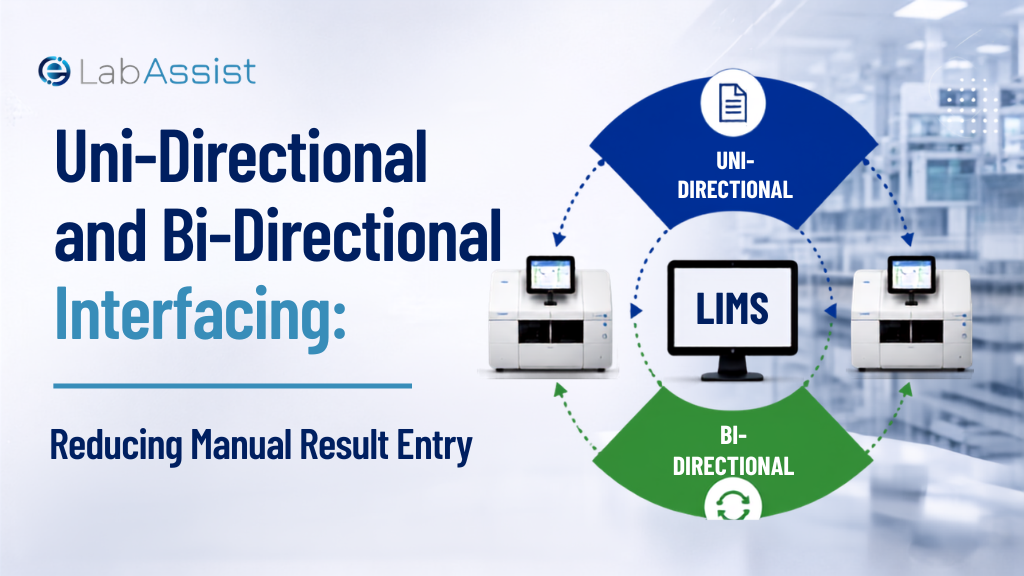
Uni-Directional and Bi-Directional Interfacing: Reducing Manual Result Entry
July 30, 2026
Introduction: The Interfacing Decision
For laboratory directors across Africa making decisions about automation infrastructure, one question recurs: Should we implement uni-directional interfacing (where analyzers send results to the LIMS) or invest in bi-directional capability (where the LIMS and analyzers communicate both ways)?
The answer is neither simple nor one-size-fits-all. Both approaches reduce manual errors and improve efficiency compared to entirely manual workflows. But they differ significantly in scope, cost, implementation complexity, and long-term scalability.
This article provides a comprehensive, decision-focused comparison tailored to lab directors managing multi-site networks, navigating diverse infrastructure challenges, and scaling operations across African markets. We’ll examine both modes in detail, explore how they address the specific pain points of high-volume, multi-analyzer labs, and provide a framework for choosing the right approach for your organization.
What Is Lab Interfacing and Why It Matters
Lab interfacing is automated communication between laboratory analyzers (chemistry, hematology, immunoassay, molecular instruments) and your Laboratory Information System (LIMS). Instead of manually reading results from analyzer displays and typing them into the LIMS, interfacing software captures data automatically, validates it, and routes it to patient records.
The Manual Alternative: Why It Fails at Scale
In labs without interfacing, the workflow looks like this:
- Technician manually enters test orders into the analyzer
- Analyzer processes samples and displays results
- Technician reads results and manually types them into the LIMS
- Results are transcribed again for reporting (spreadsheet, PDF, or HIS)
- Quality officer reviews results before release
Each manual step introduces risk: transcription errors, patient ID mismatches, unit confusion, duplicate entries. In a lab processing 500+ tests daily, even a 0.5% error rate means 2-3 mis-reported results per day, accumulating to 500-750 errors per year.
Interfacing eliminates these touchpoints. By automating data capture and transmission, labs achieve the dual benefits of reduced errors and faster turnaround times.
Uni-Directional Interfacing: Definition, Workflow, and Limitations
What Is Uni-Directional Interfacing?
Uni-directional interfacing enables one-way communication: analyzers send results to the LIMS automatically, but the LIMS cannot transmit data back to the analyzers.
Typical Uni-Directional Workflow
- Technician manually enters patient demographics and test orders into the LIMS
- Technician prints test order labels, loads samples onto analyzer
- Analyzer processes samples and generates results
- Analyzer automatically transmits results to LIMS via serial cable, TCP/IP, or middleware
- LIMS receives results, matches them to patient records via barcode or patient ID
- Technician or system reviews results; if flagged, manual inspection occurs
- Results are released to clinicians
What Uni-Directional Eliminates
- Manual result entry: Technician no longer types results from analyzer display into LIMS
- Transcription errors: No more mistyped values, decimal place errors, or copy-paste mistakes in result data
- Duplicate entry: Results are captured once from the analyzer, reducing duplication risks
What Uni-Directional Does NOT Eliminate
- Manual test order entry: Technician must still enter each test order into the analyzer (no closed-loop confirmation)
- Order-result matching errors: If patient ID is entered incorrectly into the LIMS, results may attach to wrong patient
- Manual verification step: Results still require manual review before release (limited autoverification)
- Reflex testing complexity: If test results trigger secondary tests, technician must manually initiate them
Best For: Labs transitioning from entirely manual workflows, labs with limited IT resources, or labs seeking quick wins in error reduction without major infrastructure investment.
Bi-Directional Interfacing: Closed-Loop Automation
What Is Bi-Directional Interfacing?
Bi-directional interfacing enables two-way communication between LIMS and analyzers. The LIMS sends test orders to the analyzer, and the analyzer automatically returns validated resultscreating a closed-loop system.
Typical Bi-Directional Workflow
- Technician enters patient demographics and test orders once into the LIMS (single data entry point)
- LIMS automatically transmits test orders to the appropriate analyzer
- Sample barcode triggers analyzer to retrieve test details from the LIMS
- Analyzer processes sample and generates results
- Analyzer automatically sends results back to LIMS
- Middleware applies validation rules: delta checks, reference range checks, plausibility checks
- Results meeting quality criteria are autoverified and released without manual review
- Flagged results are routed to technician for manual inspection
What Bi-Directional Eliminates
- All manual data entry: Test orders enter the system once; no re-entry into the analyzer
- Order-result matching errors: Analyzer receives orders directly from LIMS, eliminating manual patient ID confusion
- Transcription and duplicate errors: Results flow automatically with no human transcription step
- Reflex testing delays: Secondary tests are triggered automatically based on configured rules
- Manual result review: Autoverification workflows enable qualified results to be released without manual inspection
- Inter-analyzer confusion: Multiple analyzers can be managed through a single test-order entry point
Additional Capabilities of Bi-Directional Systems
- Autoverification: Results meeting predefined criteria (normal range, no flags, etc.) are automatically verified and released
- Delta checks: Compares new results to previous results; flags significant changes that may indicate pre-analytical errors
- Reflex testing: Automatically triggers secondary tests based on primary result values (e.g., if glucose is critical, order HbA1c)
- Multi-site coordination: Central LIMS can manage orders across multiple analyzers at multiple sites
- Real-time QC tracking: Analyzer QC results are captured automatically, supporting regulatory compliance
Detailed Comparison: Uni vs Bi-Directional
Aspect |
Uni-Directional |
Bi-Directional |
Data Flow Direction |
Analyzer → LIMS (one-way) |
LIMS ↔ Analyzer (two-way closed-loop) |
Manual Test Order Entry |
✗ Required |
✓ Eliminated |
Manual Result Entry |
✓ Eliminated |
✓ Eliminated |
Error Reduction Potential |
30-50% (result entry only) |
95-98% (all manual touchpoints) |
Autoverification Capability |
✗ Limited |
✓ Full |
Reflex Testing Support |
✗ Manual |
✓ Automatic |
Multi-Analyzer Management |
Independent connections |
Centralized, coordinated |
Implementation Complexity |
Low-Moderate |
Moderate-High |
Setup Timeline |
4-8 weeks |
12-20 weeks |
ROI Timeline |
18-24 months |
12-18 months |
Scalability |
Moderate (each analyzer separate) |
Excellent (grows with organization) |
Error Reduction: Which Mode Performs Better?
Sources of Lab Errors in Manual Workflows
Research in clinical laboratory quality identifies these primary error categories:
- Pre-analytical errors (25-30%): Sample collection, handling, patient ID mismatch largely outside interfacing scope
- Analytical errors (10-15%): Instrument malfunction, calibration drift not addressed by interfacing
- Post-analytical errors (60-65%): Result entry errors, patient record matching, transcription mistakes, failed communication interfacing directly addresses these
- Uni-Directional Error Reduction
Uni-directional interfacing eliminates result entry errors (a major post-analytical source). Expected improvements:
- Result transcription errors: 95-98% reduction (no more manual typing)
- Result duplication: 80-90% reduction (single capture point)
- Overall post-analytical error rate: 30-50% reduction (addresses only result entry, not order entry or verification delays)
Bi-Directional Error Reduction
Bi-directional interfacing eliminates ALL manual data entry touchpoints. Expected improvements:
- Test order entry errors: 95-98% reduction (no manual analyzer order entry)
- Result transcription errors: 95-98% reduction
- Patient ID mismatches: 90-95% reduction (orders transmitted directly from LIMS)
- Reflex testing delays: 100% reduction (triggered automatically)
- Overall post-analytical error rate: 95-98% reduction
Implementing Interfacing in Diverse African Environments
Challenge 1: Power and Connectivity Variability
African diagnostic networks operate across wide ranges of infrastructure reliability:
- Tier-1 cities (Johannesburg, Lagos, Nairobi, Cape Town) with stable grid power and broadband connectivity
- Tier-2 regional centers with intermittent power and variable internet quality
- Tier-3 remote clinics with limited power backup and 3G/4G data only
Impact on Interfacing: Cloud-based LIMS and middleware require stable connectivity. Power disruptions can interrupt communication, leaving analyzers offline.
Solution: Modern solutions support hybrid architectures with local caching. If cloud connection fails, local middleware queues results and synchronizes upon reconnection. This maintains analyzer operation even when cloud LIMS is temporarily unreachable.
Challenge 2: Multi-Site Sample Consolidation
Many African diagnostic networks operate hub-and-spoke models: collection centers in towns send samples to central processing labs in major cities. Samples may travel 50-500 km, taking 4-24 hours.
Impact on Interfacing: Test orders must originate from patient records in one location (collection center) but be processed in another (central lab). Results must route back to the originating site for clinician reporting.
Solution: Bi-directional interfacing with centralized LIMS enables this seamlessly. Orders entered at any site are routed to the central lab’s analyzers, results are automatically captured and routed back to the originating site’s records, and reports are automatically generated locally.
Challenge 3: Multiple Analyzer Brands and Legacy Equipment
Budget constraints mean African labs often operate mixed analyzer fleets: newer Roche instruments alongside older Siemens equipment, plus point-of-care devices from Abbott or Alere.
Impact on Interfacing: Each analyzer brand uses different communication protocols and data formats. Coordinating these through a single interface requires sophisticated middleware.
Solution: Enterprise middleware platforms support multiple analyzer brands and protocols (HL7, ASTM, proprietary). Choose vendors that explicitly list your existing analyzer models in their compatibility matrix. For legacy equipment without modern interfaces, some vendors offer serial-port converters or custom adapters.
Challenge 4: Compliance Across Multiple Standards
African labs may be accredited under different standards depending on location and patient base:
- NABL (India-affiliated, growing in East/Southern Africa)
- NABH (Healthcare providers across India and parts of Africa)
- SADCAS (Southern African Development Community Accreditation Service)
- ISO 15189:2022 (universal reference standard)
Impact on Interfacing: Each standard has specific requirements for audit trails, data integrity, error logging, and validation documentation. A single interfacing solution must satisfy multiple regulatory frameworks.
Solution: When evaluating middleware and LIMS, verify that vendors have implemented these specific standards and can generate compliance reports for regulatory inspections. Ask for references from labs accredited under your target standards.
Phased Implementation: Starting with Uni, Upgrading to Bi
A Practical Pathway for Risk-Averse Organizations
Not all labs are ready for full bi-directional automation immediately. Many labs benefit from a phased approach:
Phase 1: Uni-Directional Pilot (Months 1-4)
Objective: Validate interfacing concept with low risk, build organizational confidence, train staff.
Scope: Connect 1-2 high-volume analyzers (e.g., main chemistry, hematology) to LIMS using one-way result transmission.
Benefits Realized: 30-40% error reduction, 10-15% TAT improvement, staff gains familiarity with automated workflows.
Phase 2: Uni-Directional Full Rollout (Months 5-8)
Objective: Extend one-way interfacing to all analyzers, establish operational stability.
Scope: Connect all remaining analyzers (immunoassay, molecular, coagulation, etc.) to uni-directional interface.
Benefits Realized: 45-50% error reduction across all result types, 15-20% TAT improvement, staff comfortable with automated result flow.
Phase 3: Bi-Directional Upgrade (Months 9-16)
Objective: Activate test-order transmission and autoverification, realize full automation benefits.
Scope: Configure LIMS and middleware for two-way communication; define autoverification rules, delta checks, and reflex testing protocols.
Benefits Realized: 95-98% error reduction, 30-40% TAT improvement, 60% reduction in technical workload, autoverification releases 80-90% of routine results.
Advantages of Phased Implementation
- Risk Mitigation: Issues discovered in Phase 1 are addressed before full-scale rollout
- Staff Adaptation: Technicians gradually adjust to automated workflows rather than facing sudden process change
- ROI Timing: Uni-directional delivers quick wins (error reduction, cost savings) that help justify Phase 3 investment
- Flexibility: If business priorities shift, you’ve still achieved substantial benefits at Phase 2
- Budget Spread: Phased costs are more manageable than upfront lump investment
Decision Framework: Which Mode Is Right for Your Lab?
Choose Uni-Directional If:
- Lab processes <100,000 tests/year (limited throughput)
- Primary pain point is result entry errors, not order entry
- Budget is tight; maximum $25K-30K available for automation
- IT resources are limited; prefer simple, proven solutions
- Existing LIMS is basic and not designed for two-way communication
- Lab is in a phased approach, starting with quick wins
- Scaling is not an immediate priority; focus is efficiency in current workflow
Choose Bi-Directional If:
- Lab processes 150,000+ tests/year or is growing rapidly
- Multi-site network with hub-and-spoke or federated structure
- Budget allows for $55K-$100K investment
- Long-term goal is to automate all manual data-entry touchpoints
- Compliance requirements are strict (NABL, NABH, ISO 15189)
- Autoverification and reflex testing are important for clinical efficiency
- Lab plans significant expansion or new analyzer acquisitions
- Leadership prioritizes patient safety and error minimization
Decision Checklist
- Document current error rates and sources (where do mistakes happen?)
- Calculate annual test volume and growth trajectory
- Estimate current staff time spent on manual data entry
- Define compliance and accreditation requirements
- Assess IT capacity and infrastructure readiness
- Evaluate budget constraints and multi-year financial planning
- Consult with clinical and technical staff (who will use the system?)
- Research vendor solutions that match your analyzer brands and LIMS platform
- Request pilot or trial access before final commitment
Future-Proofing: Interfacing and the Evolution of Lab Networks
The Shift Toward Health System Integration
African health systems are increasingly moving toward integrated information networks. Examples include:
- ABDM (Abstraction and Delivery of Medical Data): India’s national health data framework, rapidly adopted in Indian labs
- NDHI (National Digital Health Infrastructure): Planned systems in multiple African countries to share lab results with clinicians, public health authorities, and insurers
- EHR-HIS Integration: Hospital information systems need to pull lab results directly, creating demand for LIMS-to-HIS interfacing
Implication: Labs that invest in modern interfacing infrastructure today will be better positioned to integrate with health networks tomorrow.
Standards and Future-Proofing
When choosing interfacing solutions, prioritize vendors that support:
- HL7 v2.x: Current standard for lab-to-hospital communication (widely supported)
- HL7 FHIR: Emerging standard for modern health data exchange; enables cloud-based interoperability
- ASTM Standards: For analyzer-to-LIMS connectivity
FHIR-capable solutions are more future-proof, enabling easier integration with government health networks and electronic health records as they mature across Africa.
AI and Predictive Capabilities
As data flows reliably from analyzers to LIMS to EHRs, opportunities emerge for AI-based analytics:
- Predictive algorithms that flag critical values before they’re reported
- Automated reflex testing recommendations based on patient history
- Epidemiological surveillance (e.g., tracking disease patterns across a health system)
Labs with robust bi-directional interfacing infrastructure will be ready to leverage these capabilities as they become available.
Conclusion: Building Reliable, Scalable Diagnostic Networks
For diagnostic labs across Africa, the question is not whether to implement interfacing it is which mode to implement and when.
Uni-directional interfacing provides a pragmatic entry point: it eliminates the largest single source of post-analytical errors (result transcription), improves turnaround times by 10-15%, and requires moderate investment. For labs with tight budgets, limited IT resources, or phased implementation strategies, uni-directional is a solid first step.
Bi-directional interfacing is the endgame: a closed-loop system that eliminates all manual data-entry touchpoints, delivers 95-98% error reduction, and enables autoverification workflows that can release 85-90% of routine results without manual review. For multi-site networks, high-volume labs, and organizations prioritizing long-term scalability, bi-directional is worth the upfront investment.
Critically, both approaches require the right supporting infrastructure: reliable middleware, LIMS platforms designed for automation, trained technical staff, and governance processes for validation and compliance. A poorly implemented interfacing system creates more problems than it solves.
The labs succeeding across African markets are those that take a methodical approach: assess current errors and pain points, define success metrics, choose the right technology partners, implement carefully with staff buy-in, and plan for future integration with health systems. Whether you start with uni-directional or commit directly to bi-directional, the trajectory is clear: toward less manual work, fewer errors, faster results, and diagnostic networks capable of supporting patient care at scale.