
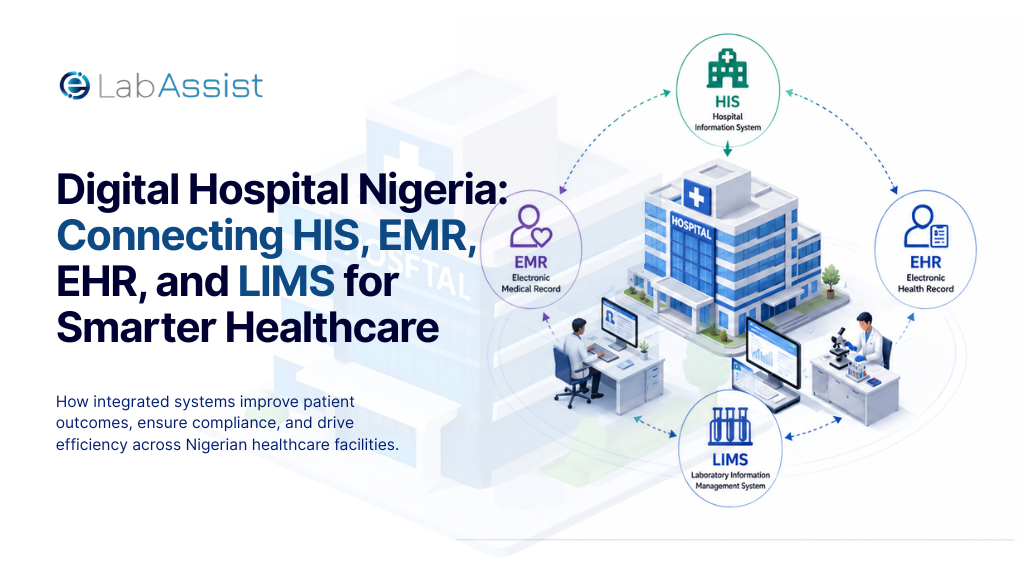
Digital Hospital Nigeria: Connecting HIS, EMR, EHR, and LIMS for Smarter Healthcare
July 1, 2026
Nigeria’s healthcare system is at an inflection point. Across Lagos, Abuja, Port Harcourt, and dozens of smaller cities, hospitals are grappling with a problem that is as much organisational as it is clinical: their systems don’t talk to each other.
A patient walks into a hospital, sees a doctor, gets referred for lab tests, and then somewhere between the clinician’s order and the laboratory’s result the information breaks down. Paper requisitions get misplaced. Results are entered manually into multiple systems. Turnaround times stretch. Clinicians make decisions on incomplete data.
This is not a failure of skill or intent. It is a failure of integration.
The concept of the digital hospital is gaining serious traction in Nigeria, driven by federal healthcare reform goals, growing HMO adoption, and pressure from international accreditation bodies. But “digital hospital” means very little unless the four core systems the Hospital Information System (HIS), Electronic Medical Record (EMR), Electronic Health Record (EHR), and Laboratory Information Management System (LIMS) are properly connected.
This article explains what each system does, why their integration matters, and what it practically looks like when Nigerian healthcare facilities get it right.
What Does “Digital Hospital” Actually Mean in the Nigerian Context?
The phrase “digital hospital” is often used loosely. In practice, it refers to a healthcare facility where clinical, administrative, and laboratory workflows are managed through interconnected digital systems, rather than through fragmented paper-based or siloed software tools.
For Nigeria, this means moving away from scenarios where:
- Doctors write handwritten lab request forms
- Lab staff manually transcribe results into a patient file
- Hospital billing teams re-enter data from lab reports
- NHIS/HMO claim submissions rely on paper-based documentation
- Public health surveillance data (like NCDC disease reporting) is compiled manually at the end of the week
A genuinely digital hospital replaces all of these with connected, real-time data flows.
The Four Systems at the Centre of It All
Understanding how these systems relate to each other is the first step.
Hospital Information System (HIS): The administrative backbone of a hospital. Manages patient registration, bed management, billing, appointments, and insurance claims. Think of it as the operational layer.
Electronic Medical Record (EMR): A digital record of a patient’s clinical interactions within a single facility. Includes consultation notes, diagnoses, prescriptions, and referrals. It is facility-specific.
Electronic Health Record (EHR): A broader, longitudinal record of a patient’s health history, ideally shareable across multiple healthcare providers. It captures the patient’s full health journey across hospitals, clinics, and laboratories.
Laboratory Information Management System (LIMS): The system that manages everything that happens inside a laboratory from sample collection and tracking to test processing, result validation, quality control, and report delivery. A LIMS is not a basic result-entry tool; a properly configured one manages chain-of-custody, TAT monitoring, barcode sample tracking, and quality compliance documentation.
Each of these systems exists to solve a specific problem. The real value, however, comes when they are connected.
Why Integration Is the Core Challenge for Nigerian Hospitals
In most Nigerian hospitals public and private these systems currently operate in silos, if they have been digitised at all. The HIS might track billing, the EMR might store consultation notes, and the laboratory might have its own standalone software (or still be using spreadsheets). None of them share data automatically.
The consequences are tangible:
- Delayed diagnoses: Results that should reach a clinician within two hours take a day because they are printed, manually collected, and physically walked to the ward.
- Data entry errors: When lab results are re-typed from one system into another, transcription errors increase clinical risk.
- HMO claim rejections: NHIS and HMO schemes increasingly require documented, auditable clinical pathways. Gaps in integrated documentation lead to rejected claims and revenue loss.
- Weak disease surveillance: NCDC disease reporting depends on accurate, timely lab data. Manual compilation introduces delays and inaccuracies that undermine public health response.
Integration solves these problems, but it requires both the right technical standards and the right systems on either end of the connection.
How HL7 and FHIR Make Integration Possible
Any discussion of HIS-EMR-EHR-LIMS integration inevitably involves two technical standards: HL7 and FHIR.
HL7 (Health Level Seven) is a long-established set of international standards for the exchange of clinical and administrative data between healthcare systems. It defines how messages are structured so that a lab result generated in one system can be read and processed by another.
FHIR (Fast Healthcare Interoperability Resources) is a newer, API-based standard developed by HL7. It uses modern web technologies (REST APIs, JSON, XML) to make health data exchange faster, more flexible, and more accessible to developers building healthcare applications.
For Nigerian hospitals investing in digital infrastructure, choosing systems that support HL7 and FHIR is not optional it is the difference between building something that can grow and adapt, and investing in a closed ecosystem that creates new silos.
A LIMS that supports FHIR, for instance, can send validated lab results directly into a patient’s EMR the moment a result is authorised with no manual step in between.
The Laboratory’s Role in the Digital Hospital
The laboratory is frequently treated as a downstream function a service department that receives requests and returns results. This framing underestimates the laboratory’s role in clinical decision-making.
In practice, laboratory data drives a significant proportion of clinical decisions. Diagnosis confirmation, medication dosing, disease staging, infection surveillance all of these depend on reliable, timely laboratory results.
This is why a well-integrated LIMS is not just a laboratory efficiency tool. It is a core clinical infrastructure component.
What Integration Between LIMS and EMR/HIS Looks Like in Practice
When a LIMS is properly integrated with an EMR and HIS, the workflow changes substantially:
- The clinician orders a test inside the EMR. No paper form. The order is transmitted electronically to the LIMS.
- The LIMS receives the order and generates a barcode-labelled sample collection request. The phlebotomist scans the patient’s wristband, and the sample is tracked from collection through processing.
- The laboratory processes the sample and validates the result. The LIMS enforces QC checkpoints; no result can be reported without passing the appropriate validation step.
- The authorised result is transmitted back to the EMR and, where relevant, the HIS for billing automatically. TAT is logged against the original order time.
- If the result triggers a critical value, the system flags it immediately. The clinician is notified in the EMR before they would have otherwise checked.
This is not a theoretical scenario. It is standard workflow in hospitals that have invested in properly integrated systems.
NCDC Surveillance Integration
For public health-relevant tests malaria, typhoid, tuberculosis, HIV, and notifiable communicable diseases — integration between the LIMS and NCDC surveillance systems like SORMAS (Surveillance Outbreak Response Management and Analysis System) creates a direct data pipeline. Instead of lab coordinators compiling weekly reports manually, positive results for notifiable conditions can be flagged and reported through structured data channels in near-real-time.
This matters for outbreak response. The speed of NCDC’s response to disease clusters depends, in part, on the timeliness and accuracy of the data it receives from frontline laboratories.
HMO and NHIS Compliance: Integration as a Financial Imperative
Nigeria’s health insurance landscape spanning NHIS schemes, state health insurance programmes, and the growing private HMO market is increasingly demanding structured, digital documentation of clinical and laboratory services.
For a diagnostic laboratory or hospital laboratory to receive payment from an HMO, it typically needs to demonstrate:
- That the test was clinically ordered by an authorised clinician
- That the sample was collected and processed according to standard protocols
- That the result was validated and released by a qualified professional
- That the full transaction is documented with timestamps
An integrated LIMS creates this audit trail automatically. The chain-of-custody log, the TAT record, the result authorisation sign-off — all of it is captured without any additional documentation effort.
Laboratories operating on standalone systems, or worse, on paper, struggle to produce this documentation efficiently. It is one of the underappreciated reasons why some diagnostic facilities face persistent claim delays.
WhatsApp-First Patient Communication and Digital Results Delivery
One of the most Nigeria-specific aspects of healthcare digitisation is the role of WhatsApp in patient communication. In a country where smartphone penetration is high and WhatsApp is the dominant communication platform, many patients expect to receive their results or at least a notification via WhatsApp.
A modern LIMS can support this through automated result delivery workflows. Once a result is validated and released, a notification (or a digital report link) can be sent directly to the patient’s WhatsApp or SMS. This eliminates the need for patients to return to the lab or call for results, which is particularly relevant for diagnostic labs serving outpatients across large cities.
This is not about replacing clinical counselling for sensitive results — it is about removing friction for the routine, high-volume tests that form the bulk of diagnostic workload.
ISO 15189 and NABL: How Integration Supports Accreditation
Many Nigerian diagnostic laboratories are working towards or already hold ISO 15189 accreditation, which is the international standard for medical laboratory quality and competence. NABL (National Accreditation Board for Testing and Calibration Laboratories) accreditation is also relevant for labs serving clients that require internationally recognised quality standards.
Both standards require documented quality management processes, including:
- Documented sample handling procedures
- QC records with traceability
- Proficiency testing participation and records
- Corrective action documentation
An integrated LIMS doesn’t just make these records easier to maintain it makes them continuous and searchable. During an accreditation audit, a lab manager can pull up a complete quality record for any test, at any point in time, in seconds.
This is one of the strongest practical arguments for LIMS adoption that goes beyond “efficiency.” It is about building the documented quality infrastructure that supports institutional credibility.
What Nigerian Hospitals Should Look for in a LIMS
Not every LIMS is designed for the Nigerian healthcare environment. When evaluating options, hospital administrators and lab managers should consider:
- HL7/FHIR support: Can it integrate with existing HIS and EMR systems?
- Cloud-based deployment: Is it accessible from multiple sites without requiring complex on-premise IT infrastructure?
- Multi-branch support: Does it allow a group of labs or a hospital network to manage operations centrally?
- Local compliance features: Does it support NHIS/HMO documentation requirements?
- Barcode sample tracking: Does it provide chain-of-custody tracking from sample collection through result release?
- TAT monitoring: Does it track turnaround times and generate alerts for breaches?
- Quality control tools: Does it enforce QC before results can be authorised?
- Patient result delivery: Does it support digital report delivery via email, SMS, or WhatsApp notification?
- AI-assisted reporting: Does it offer intelligent interpretation aids or smart report generation to support pathologists?
These are not nice-to-haves. In an environment where NHIS compliance, HMO claim accuracy, and ISO 15189 documentation are business-critical, they are operational necessities.
eLabAssist: Built for Connected Laboratory Operations
eLabAssist is a cloud-based LIMS platform designed with the operational realities of diagnostic and hospital laboratories in mind. It supports HL7/FHIR integration, enabling it to connect with existing HIS and EMR systems in hospital environments.
Its features including barcode sample tracking, TAT monitoring, chain-of-custody audit trails, AI Smart Reports, and multi-branch management are designed to support the kind of integrated, accountable laboratory workflow that digital hospitals require.
For Nigerian laboratories navigating the demands of NHIS compliance, HMO documentation, NCDC surveillance reporting, and ISO 15189 accreditation, eLabAssist provides a platform that addresses these requirements without requiring a large, complex IT infrastructure to run it.
If you are evaluating LIMS options for a hospital laboratory, diagnostic centre, or multi-site lab network in Nigeria, eLabAssist is worth exploring. You can learn more at elabassist.com.
Conclusion
The digital hospital is not a single product or platform. It is an outcome the result of connecting the right systems so that clinical, laboratory, and administrative data flows without friction across the care pathway.
In Nigeria, where healthcare demand is growing, HMO adoption is expanding, and public health surveillance requirements are becoming more demanding, the pressure to build integrated digital infrastructure is real and increasing.
The laboratory sits at the centre of this challenge. It generates data that clinicians depend on, that HMOs audit, and that public health systems need. A well-integrated LIMS connected to the HIS, the EMR, and the broader health information ecosystem — transforms the laboratory from a cost centre into a clinical intelligence hub.
Getting there requires deliberate choices about systems, standards, and implementation. But the direction of travel is clear: Nigerian hospitals that invest in connected digital infrastructure today will be better positioned to deliver quality care, satisfy payers, and meet regulatory expectations in the years ahead.
Frequently Asked Questions
- What is a digital hospital in Nigeria? A digital hospital in Nigeria is a healthcare facility that uses connected digital systems including an HIS, EMR, EHR, and LIMS to manage clinical, administrative, and laboratory workflows. The goal is to eliminate paper-based processes and ensure that patient data flows seamlessly between departments and systems.
- What is the difference between an EMR and an EHR? An EMR (Electronic Medical Record) is a digital record of a patient’s interactions at a single facility. An EHR (Electronic Health Record) is broader it captures a patient’s health history across multiple providers and can be shared between facilities. In practice, many Nigerian hospitals use the terms interchangeably, though they serve distinct functions in a fully integrated system.
- Why does a hospital LIMS need to integrate with the HIS and EMR? Without integration, laboratory test orders and results have to be entered manually into multiple systems, which increases the risk of errors, delays TAT, and creates gaps in the clinical record. An integrated LIMS receives orders electronically and returns validated results directly to the clinician’s EMR, creating a seamless, auditable workflow.
- How does LIMS integration support NHIS and HMO compliance in Nigeria? NHIS and HMO claim processing increasingly requires documented evidence of clinical ordering, sample handling, and result authorisation. An integrated LIMS automatically generates this audit trail including timestamps, authorisation records, and TAT data making it far easier to submit accurate, well-documented claims.
- What are HL7 and FHIR, and why do they matter for Nigerian hospitals? HL7 and FHIR are international standards for exchanging clinical data between healthcare systems. Any hospital or laboratory investing in digital infrastructure should ensure their systems support these standards, because they determine whether different platforms HIS, EMR, LIMS can share data effectively.
- Can a cloud-based LIMS work reliably in Nigeria given connectivity challenges? Cloud-based LIMS platforms are designed to function in variable connectivity environments, and many modern platforms include offline capabilities for critical functions with data synchronisation when connectivity is restored. That said, a stable internet connection significantly improves the experience. Labs should evaluate platforms based on their specific connectivity infrastructure.
- What is the relationship between LIMS integration and ISO 15189 accreditation? ISO 15189 requires comprehensive quality documentation including sample handling records, QC logs, and result authorisation trails. A well-configured LIMS captures all of this automatically and makes it searchable and auditable. For laboratories working towards ISO 15189 or NABL accreditation, an integrated LIMS substantially reduces the documentation burden.