
Diagnostic Lab Expansion in Tier-2 & Tier-3 Cities India: The Proven 8-Step Blueprint
June 15, 2026
Why Diagnostic Lab Expansion in Tier-2 Cities India Is the #1 Opportunity in 2026
If you run a diagnostic lab in Mumbai, Bengaluru, Delhi, or Hyderabad, you have probably noticed something uncomfortable over the last two years: more competitors, lower margins, patients shopping on price, and revenue per test declining 8–12% since 2023. That is market saturation, and it is accelerating. Meanwhile, diagnostic lab expansion in tier-2 cities India is growing at 25%, more than double the metro rate of 10% and the gap is widening every quarter. Agilus Diagnostics already earns 60% of its total revenue from tier-2 and tier-3 cities. Redcliffe Labs derives nearly 60% of revenues from these areas with 80% of its network in smaller towns. Metropolis Healthcare is present in over 700 towns and targeting 1,000 within 18 months, reporting 23% year-on-year revenue growth from tier-3 cities alone.
The opportunity in diagnostic lab expansion in tier-2 cities India is not just about growth rates it is about the sheer scale of unmet patient need. Only 25% of populations in semi-rural and rural areas have access to modern healthcare facilities nearby, according to IMARC Group’s 2025 diagnostic market report. That infrastructure gap is the market. Labs that reach these patients first with quality services and digital infrastructure are not just capturing market share they are building the entire organised diagnostic ecosystem in these towns from the ground up. And when a patient in Sehore or Sindhudurg receives their blood test on WhatsApp from your lab and gets a call back from your team, they do not switch to the next lab that opens. Brand loyalty in smaller cities, once earned, is extraordinarily durable.
The India diagnostic labs market was valued at USD 18.41 billion in 2024 and is projected to reach USD 34.68 billion by 2030 at a 10.90% CAGR, according to Expert Market Research’s 2025 India Diagnostic Labs report. Pathology lab services alone reached USD 19.5 billion in 2025. The Ayushman Bharat Health Infrastructure Mission is investing ₹64,180 crore to establish 730 Integrated District Public Health Laboratories across the country and these are concentrated precisely in tier-2 and tier-3 districts, creating a public health demand that private diagnostic labs are uniquely positioned to serve alongside. For a practical starting point on which software to choose, our guide on cloud LIMS vs on-premise LIMS covers the deployment decision that determines whether your expansion infrastructure scales or stalls.
4 Costly Mistakes That Sink Diagnostic Lab Expansion in Tier-2 Cities India
Every year, diagnostic labs attempt diagnostic lab expansion in tier-2 cities India with a metro mindset, same systems, same staffing assumptions, same infrastructure expectations and pay dearly for it. Understanding what goes wrong before you invest is the single most valuable preparation you can do. These four mistakes account for the majority of failed or underperforming smaller-city expansions.
Mistake 1: Choosing a LIMS not built for low-bandwidth
Many tier-2 and tier-3 towns still experience 4–8 hours of load shedding and rely on 2G/3G internet. A cloud LIMS that requires constant high-bandwidth connectivity fails silently sample registration stops, barcodes don’t print, results don’t transmit. Labs discover this at the worst possible time: a busy Monday morning with 80 samples waiting.
Require your LIMS vendor to demonstrate offline-first operation full sample registration, barcode printing, and basic processing without any internet connection, with automatic sync on reconnection. Test this in the actual connectivity conditions of your target location before you sign anything.
Fix: Offline-capable cloud LIMS
Mistake 2: Over-investing in equipment at spokes too early
A common trap: equipping every spoke with the same instrumentation as the hub, before sample volumes justify it. A fully equipped spoke lab processing 30 samples per day has idle capital in depreciating equipment and inflated AMC costs that make the location unprofitable for 18 months or more.
Start each spoke with right-sized equipment for the expected daily volume: a 3-part CBC, basic biochemistry panel, and rapid antigen platform for the most prevalent local conditions. Route everything else to the hub via the LIMS. Upgrade equipment when LIMS volume data tells you the throughput justifies it not before.
Fix: LIMS-driven volume-based upgrades
Mistake 3: Relying on walk-in traffic to build volume
In tier-2 and tier-3 cities, patient foot traffic to diagnostic labs builds slowly, sometimes very slowly. Labs that open without a home collection capability and a doctor referral programme often spend 6–9 months at 20% of target volume, burning cash while waiting for walk-ins that come primarily through word of mouth.
Launch home collection and doctor outreach before the physical lab opens. Take bookings via WhatsApp, assign phlebotomists through your LIMS route management, and deliver reports digitally. Build the reputation in the community before you open the doors. Patients and doctors will already know your brand when the lab opens.
Fix: Home collection + doctor outreach first
Mistake 4: Using separate software systems per branch
Labs that use different LIMS or billing software at each branch end up with fragmented data, no consolidated HQ visibility, and massive manual work to reconcile financials, QC records, and sample tracking across locations. NABL audit preparation becomes a months-long manual exercise and compliance non-conformances multiply.
One LIMS, all branches, from day one. A centralised multi-branch cloud LIMS gives HQ real-time visibility across every location, sample status, QC flags, TAT performance, revenue vs target and generates NABL-compliant audit trails centrally without any manual compilation.
Fix: Centralised multi-branch cloud LIMS
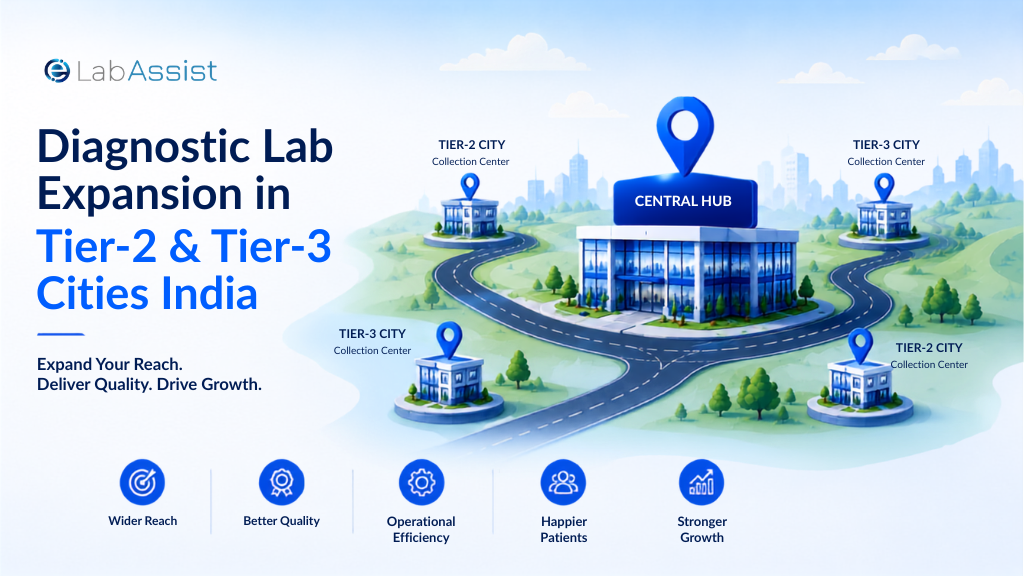
The Hub-and-Spoke Model: The Proven Structure for Diagnostic Lab Expansion in India
The most important strategic decision in any diagnostic lab expansion in tier-2 cities India programme is the network architecture. Every major Indian diagnostic chain Dr Lal PathLabs, Metropolis, Thyrocare, Redcliffe uses the hub-and-spoke model for their smaller-city expansion. It is not a coincidence. It is the structure that makes diagnostic lab expansion in tier-2 cities India economically viable without the capital requirements of full standalone labs at every location.
The hub-and-spoke model works as follows: your hub lab is a fully equipped central processing facility typically in a Tier-1 or large Tier-2 city with advanced instruments, NABL accreditation, specialist pathologists, and the complete test menu. Spoke labs are smaller collection and basic-processing centres in surrounding Tier-2 and Tier-3 towns. Routine tests CBCs, basic metabolic panels, urinalysis process at the spoke. Complex, specialised, or low-volume tests travel to the hub via the daily sample transport run. The LIMS connects the entire network in real time: every sample is barcoded at the spoke, tracked through transport, received at the hub, processed, validated by the pathologist digitally, and the report delivered back to the patient at their doorstep on WhatsApp before they’ve even driven home from the collection centre.
The economics are compelling. A collection-centre spoke can be established for ₹3-8 lakhs a fraction of what a full standalone lab costs. You do not duplicate expensive equipment or senior pathologist salaries at every location. You extend your reach through collection points while keeping complex testing centralised where it is cost-effective. As the Rural and Remote Health journal’s hub-and-spoke healthcare model analysis found, this model offers large market coverage with efficient resource utilisation and flexibility in workload distribution exactly what diagnostic lab expansion in tier-2 cities India requires. The critical enabler is ICT in our context, the cloud LIMS which resolves the logistical coordination challenges that make hub-and-spoke unworkable without digital infrastructure.
The Proven 8-Step Operational Blueprint for Diagnostic Lab Expansion in Tier-2 & Tier-3 Cities
This is the sequence that works for diagnostic lab expansion in tier-2 cities India tested across hundreds of smaller-city lab openings. Not the sequence that looks good in a business plan. The sequence that keeps quality high, samples moving correctly, and revenue growing from the first month.
1) Market assessment choose the right city for your diagnostic lab expansion in India
Not all tier-2 cities offer equal diagnostic lab expansion potential. Assess each target city for existing organised lab presence, chronic disease burden (diabetes, hypertension, TB), hospital density, insurance penetration, and doctor network strength. Cities with a government medical college, a large district hospital, or documented high chronic disease prevalence generate more consistent diagnostic demand than cities where healthcare is primarily episodic. Redcliffe Labs and Metropolis both use proprietary city-scoring models before committing investment. Your LIMS vendor should be able to provide market guidance based on their existing network data from the region.
Market intelligence first
2) Regulatory registration Clinical Establishments Act, state licensing, GST
Every diagnostic lab in India requires registration under the Clinical Establishments (Registration and Regulation) Act, 2010, now enforced in most states including Maharashtra, UP, Karnataka, and Tamil Nadu. You also need your state medical laboratory licence, GST registration, and if you handle radiology AERB registration. The Clinical Establishments Act is becoming non-negotiable even in smaller cities, and labs that skip registration face closure notices. Configure your LIMS with the correct registered entity details, branch billing addresses, and GST numbers before any patient is registered retrospective corrections are operationally painful.
Compliance before operations
3) LIMS setup configure the hub-spoke architecture before opening
Configure your multi-branch LIMS hub-spoke network before the first patient is registered. This includes setting up the hub lab entity, creating spoke lab entities with separate login credentials and location-specific test menus, configuring sample transport routing rules (which tests process at each spoke, which route to the hub), setting up barcode formats and label templates, and critically testing offline sync behaviour under the actual connectivity conditions at your target spoke location. eLabAssist LIMS can be fully configured for a new multi-branch network in 72 hours, but allow a full week for testing, staff walkthroughs, and workflow validation before go-live. Your LIMS vendor should provide dedicated implementation support for diagnostic lab expansion in tier-2 cities India ask for it explicitly.
72-hour LIMS go-live possible
4) Equipment procurement right-size for the location, not for the hub
A spoke lab processing 30–60 samples per day does not need the same instrument complement as a hub processing 500. Start each spoke with a right-sized equipment set for the local disease profile and expected volume: a 3-part differential CBC analyser, a basic 10-parameter biochemistry panel covering the most-ordered tests (glucose, creatinine, LFTs, lipids), a rapid antigen platform for malaria and dengue in endemic areas, and a urine analyser. The LIMS routes everything requiring more advanced instrumentation to the hub automatically. Review LIMS volume data at 90-day and 180-day marks to identify whether any spoke has reached the threshold for equipment investment.
LIMS data drives investment decisions
5) Staff recruitment and LIMS training standardise through systems, not people
The critical insight for staffing in diagnostic lab expansion in tier-2 cities India is that your quality standard must come from your system, not the individual. When every collection, registration, processing, and dispatch step follows a LIMS-enforced workflow with barcode scanning at each stage, automatic alerts for deviations, and remote supervisory visibility from HQ a new MLT in Kanpur can deliver the same quality as a five-year veteran in Mumbai. Recruit for DMLT qualification and attitude. Train to your LIMS protocols. Your hub pathologist remotely supervises quality through the LIMS dashboard. Plan for 2–3 hours of LIMS training for collection staff and a half-day for the branch manager before go-live.
System-enforced quality at scale
6) Home collection launch begin revenue generation before the lab opens
In most tier-2 and tier-3 cities, home collection should launch before your physical lab opens not after. Activate phlebotomist route management in the LIMS, take appointment bookings via WhatsApp Business, assign phlebotomists, and deliver reports digitally. Patients who have a positive home collection experience become your strongest community advocates. This is how Redcliffe Labs and Healthians built brand presence in tier-2 cities before having physical labs they were already delivering results to hundreds of patients by the time the walk-in centre opened, and those patients told their doctors and neighbours.
Revenue before doors open
7) Doctor outreach programme your most valuable marketing activity
In smaller cities, diagnostic lab selection is almost entirely driven by the referring doctor’s recommendation. Patients trust their GP’s advice above anything they see in an advertisement. Invest in building face-to-face relationships with every GP, paediatrician, gynaecologist, diabetologist, and ENT within 5 kilometres of each spoke. Visit in person, leave test menus, demonstrate your WhatsApp TAT with a sample result, and offer direct doctor portal access so they can view their patients’ results without calling. Set a target: at minimum 10 active referring doctors per spoke before you consider that spoke’s referral network established. One doctor who refers 10–15 patients a month is worth more than any Google ad spend in that city.
Doctor relationship = primary growth engine
8) Data-driven quality monitoring manage the network from HQ, not from a car
Once your spokes are live, the ongoing management of diagnostic lab expansion in tier-2 cities India depends on daily review of the LIMS centralised dashboard. Review every branch each morning for: TAT performance per test, QC failure rates, sample rejection rates, critical value turnaround times, and revenue vs target. Any spoke where QC failure rates increase, sample rejections spike, or TAT deteriorates is showing you an early warning signal before it becomes a patient complaint or a NABL non-conformance. The LIMS makes this possible without physically travelling to every location but the discipline of actually reviewing the data, and acting on deviations within 24 hours, is what separates networks that maintain quality at scale from those that don’t.
Daily LIMS dashboard review
Home Collection: Your Fastest Revenue Channel in Smaller Cities
Here is something that consistently surprises lab owners undertaking diagnostic lab expansion in tier-2 cities India: home collection often generates a larger share of revenue in smaller cities than in metros, sometimes significantly larger. The reason is structural. In a metro, a patient can walk to a diagnostic lab on the same street. In a tier-3 city, the nearest organised lab may be 3 kilometres away with no reliable auto or cab service available. The physical barrier to walk-in testing is real, especially for elderly patients, working women, or anyone who has taken a half-day off work just to give a blood sample. Home collection eliminates that barrier entirely. And when your competition is a standalone lab that requires patients to visit in person, offering home collection with same-day WhatsApp report delivery is not just a convenience feature it is a decisive competitive advantage that unorganised labs cannot easily replicate without the digital infrastructure you already have. For a deep dive on what LIMS home collection management requires technically, see our article on phlebotomist and home collection management with LIMS.
What your LIMS needs to manage home collection at scale in tier-2 expansion
- Online appointment booking integrated with your website, WhatsApp Business API, and patient app; patients can book without calling
- Phlebotomist assignment and route optimisation grouping appointments geographically minimises travel time and cold-chain risk in smaller-city driving conditions
- Mobile sample registration at doorstep phlebotomist registers the sample on a mobile LIMS app, prints the barcode label from a portable Bluetooth printer, and the sample enters the system before leaving the patient’s home
- Cold-chain monitoring alerts time-from-collection alerts that flag samples approaching critical handling limits if transport is delayed
- Automated patient communication chain appointment reminder → collection confirmation → “sample received at lab” notification → “report ready” with direct WhatsApp download link; no staff intervention required
Staffing Strategy for Diagnostic Lab Expansion in Smaller Cities India
The staffing challenge in diagnostic lab expansion in tier-2 cities India is real but overestimated by labs that equate quality with the seniority of individual staff members rather than the quality of their systems. According to the Business Standard report on organised diagnostic expansion in smaller cities, even national chains face staff shortages in tier-2 locations but the ones expanding successfully have designed their networks so that quality comes from standardised digital workflows, not from the tenure of individual technicians. When your LIMS enforces the protocol at every step LIMS-guided sample registration, barcode verification at collection, automatic delta checks on every result, remote pathologist validation, and AI-assisted report generation the human’s role becomes reliable protocol execution rather than clinical judgement on every result.
NABL Compliance During Diagnostic Lab Expansion in Tier-2 Cities India: What Changes
NABL accreditation under ISO 15189:2022 (NABL India) is increasingly required for insurance TPA empanelment, government tenders, and corporate diagnostic contracts and labs pursuing diagnostic lab expansion in tier-2 cities India that want access to these revenue streams need their multi-branch quality system to be audit-ready from the beginning. The good news is that a properly configured cloud LIMS does not just make NABL compliance possible across multiple locations, it makes it significantly easier to demonstrate during an assessment than the manual systems most small-city labs currently rely on. Every sample tracked, every QC event logged, every validation decision time-stamped and user-attributed, every deviation corrective action documented automatically, across every spoke, from one centralised system. The NABL assessor’s job is to verify that these records exist and are complete. Your LIMS ensures they always are.
For labs preparing their first NABL assessment as part of their diagnostic lab expansion in tier-2 cities India programme, our detailed NABL accreditation checklist for pathology labs in India covers all 25 assessment criteria and maps each one to the specific LIMS feature that satisfies it.
|
ISO 15189 Requirement |
Without Centralised LIMS |
With eLabAssist Multi-Branch LIMS |
|
Specimen identification (Cl. 5.4) |
Manual registers at each spoke inconsistent across branches |
Centralised barcode tracking uniform across all spokes from day one |
|
Chain-of-custody (Cl. 5.7) |
Paper transport manifests gaps and losses between spoke and hub |
Digital scan log from spoke collection to hub receipt fully traceable |
|
Result validation (Cl. 5.8) |
Hub pathologist unaware of spoke results until faxed or phoned |
Remote digital validation queue hub pathologist signs off all spokes in real time |
|
Internal QC (Cl. 5.6) |
QC records at each branch separately inconsistent formats, easy to miss |
Westgard QC charts auto-generated at all branches, reviewed centrally daily |
|
Audit trail for NABL assessment |
Manual compilation from multiple branch records weeks of preparation |
One-click export of complete audit trail for any branch, any period, any assessor |
|
Corrective action records (Cl. 8.7) |
Verbal corrections — not documented for assessor review |
Every LIMS flag, alert, and resolution logged automatic CAR documentation |
Frequently Asked Questions About Diagnostic Lab Expansion in Tier-2 Cities India
1) Why is diagnostic lab expansion in tier-2 cities India the best growth opportunity in 2026?
Tier-2 and tier-3 cities in India are growing at 25% CAGR compared to just 10% in metros. These cities already contribute 40% of India’s diagnostic revenue projected to reach 50% by 2027–28. Metro markets are saturating with revenue per test declining 8–12% over the last two years. Pursuing diagnostic lab expansion in tier-2 cities India before national chains dominate is the most significant growth move available in 2026.
2) What is the hub-and-spoke model for diagnostic lab expansion in India?
The hub-and-spoke model connects a central processing lab (the hub) to multiple smaller collection and processing centres (spokes) in surrounding tier-2 and tier-3 towns. Routine tests process at the spoke. Complex tests travel to the hub. A cloud LIMS connects the entire network tracking every sample from spoke collection to hub testing, digital pathologist sign-off, and WhatsApp report delivery to the patient.
3) What LIMS features are essential for diagnostic lab expansion in tier-2 cities India?
Essential LIMS features for diagnostic lab expansion in tier-2 cities India: centralised multi-branch dashboard for HQ visibility, offline-first cloud operation for low-bandwidth areas, barcode sample tracking from spoke to hub, phlebotomist route management, WhatsApp/SMS report delivery, multi-payer billing including Ayushman Bharat and CGHS, remote pathologist digital sign-off, and NABL-compliant audit trails across all branches from one system.
4) What are the 4 biggest mistakes to avoid in diagnostic lab expansion in tier-2 cities?
The 4 most costly mistakes are: (1) choosing a LIMS not built for offline/low-bandwidth operation; (2) over-investing in spoke equipment before volume justifies it; (3) relying on walk-in traffic instead of launching home collection and doctor outreach before opening; and (4) using separate software systems per branch, which fragments data and makes NABL compliance unmanageable.
5) How does home collection software support diagnostic lab expansion in tier-2 cities India?
Home collection removes the physical access barrier for patients in tier-2 and tier-3 cities. A LIMS with home collection management assigns phlebotomists to bookings, tracks their GPS location, logs sample collection via mobile barcode scan, and automatically delivers reports via WhatsApp. Labs typically see home collection grow from 15% to 3545% of revenue within 6 months of launch reaching patients who would never visit the physical lab.
6) Does NABL accreditation process change for diagnostic lab expansion in smaller cities?
NABL requirements under ISO 15189:2022 are identical regardless of city tier. However, labs attempting diagnostic lab expansion in tier-2 cities India often face higher non-conformance rates because documentation is inconsistent across branches. A cloud LIMS that auto-generates audit trails, QC records, and specimen tracking at every branch resolves this one system, one standard, every location.
Conclusion: The Proven Path Forward for Diagnostic Lab Expansion in Tier-2 Cities India
In 2026, diagnostic lab expansion in tier-2 cities India is as clear a business opportunity as exists in Indian healthcare. The demand is real and growing at 25% annually. The competition is 85% unorganised. The patients are underserved and hungry for quality, digital-first diagnostic services. The infrastructure cloud LIMS, WhatsApp, mobile internet, home collection logistics is ready. What is not permanent is the window. Metropolis is targeting 1,000 towns in 18 months. Redcliffe has 80% of its network in smaller cities already. Dr Lal PathLabs, Thyrocare, and Agilus are all executing the same strategy with national brand recognition and large marketing budgets.
The independent and regional labs that move now with the right hub-and-spoke structure, a centralised cloud LIMS, a home collection operation, and a disciplined doctor outreach programme will establish the brand loyalty in their target cities that makes them extraordinarily difficult to displace, even when the national chains arrive. In smaller cities, whoever the patient knows first and trusts first tends to stay the patient’s lab for years. The labs that wait will find themselves competing for market share in a city where patients already associate quality diagnostics with someone else’s name.
eLabAssist LIMS is built specifically for diagnostic lab expansion in tier-2 cities India: multi-branch hub-spoke architecture configured in 72 hours, offline-capable cloud operation, integrated home collection management, WhatsApp report delivery, Ayushman Bharat billing integration, and NABL-compliant audit trails across all branches from one dashboard. Over 1,500 labs across India and Africa have used it to grow beyond their first city and the operational blueprint above is drawn directly from what those expansions have taught us.