
How to Start a Franchise Diagnostic Lab in India: The LIMS Infrastructure You Need from Day One
June 10, 2026
The Franchise Diagnostic Lab Opportunity in India in 2026
India’s diagnostic industry is one of the fastest-growing healthcare segments in the world, and the franchise model is at the heart of that growth. The total diagnostics market in India is projected to cross ₹1,20,000 crore by 2030, driven by rising health awareness, deeper insurance penetration, and a massive unmet demand for quality diagnostic services in Tier 2 and Tier 3 cities.
Their franchise collection centres send samples to central processing hubs, results come back digitally, and the entire chain operates like a single coordinated lab network. That coordination is possible only because of the right software sitting underneath everything.
For an independent pathologist or a regional diagnostic brand looking to expand through the franchise route in 2026, the opportunity is real but so is the risk. The labs that struggle are almost always the ones that tried to manage multi-branch operations with software designed for a single location. The ones that scale successfully are the ones that built the right digital foundation from the very first franchise location.
Understanding the Franchise Lab Model: Hub, Spoke, and Affiliate
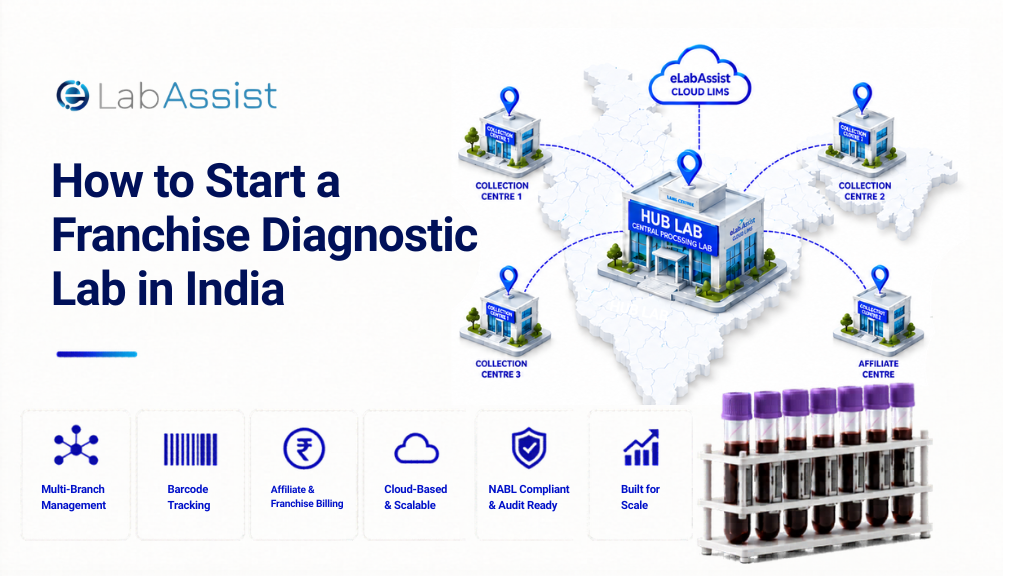
Before we get into the software, it helps to be precise about the structure you are building because the LIMS architecture has to mirror your operational model. In India’s diagnostic franchise ecosystem, there are typically three tiers:
The Hub Central Processing Lab
The hub is the heart of the franchise. This is where the instruments live: the haematology analysers, the biochemistry systems, the immunoassay platforms and where pathologists validate and sign off reports. All complex and specialised testing happens here. The hub is also where the LIMS master data lives: the test catalogue, reference ranges, pricing tiers, quality control records, and NABL documentation.
The Spoke Franchise Collection Centres
Spokes are the patient-facing locations, typically smaller spaces of 200-500 sq ft where patients walk in, register, and have their samples collected. The spoke has a phlebotomist, a front-desk executive, a barcode printer, and a scanner. There is no analyser here. Samples are packaged and transported to the hub, usually multiple times per day. The spoke’s entire workflow runs through the LIMS: registration, barcode printing, transport logging, and report delivery.
The Affiliate Referral Collection Agents
Affiliates are clinics, hospitals, nursing homes, or independent phlebotomists who refer samples to the franchise lab without operating a formal collection centre. The LIMS manages their billing separately, tracks their referral volumes, and generates monthly settlement reports. In a mature franchise operation, affiliates can account for 30-50% of total sample volume.
The Most Expensive Mistake Franchise Labs Make on Day One
Here is something that plays out in diagnostic franchises across India more often than anyone likes to admit: a pathologist opens their first franchise collection centre, buys a basic LIMS licence designed for a standalone lab, and gets started. Things work reasonably well at one location. Then a second collection centre opens, and a third.
Suddenly the cracks appear. There is no central dashboard showing sample status across all locations. The billing team is reconciling receipts manually because the software generates separate reports for each branch. The NABL assessor asks for a consolidated chain-of-custody report and gets a pile of printouts from three different systems. A sample gets processed twice because the collection centre’s register and the hub’s LIMS aren’t talking to each other.
At this point, the franchise owner faces a painful choice: rebuild their entire digital infrastructure mid-growth, migrating patient data, retraining staff, reconnecting instruments or keep managing chaos manually. Either way, the cost far exceeds what a proper multi-branch LIMS would have cost from day one.
The six infrastructure pillars below are the ones that separate a franchise lab built for scale from one that will hit a ceiling at three locations.
- Single-location LIMS with no multi-branch capability
No central dashboard, no consolidated reporting, no cross-branch sample tracking. Billing reconciliation becomes a spreadsheet nightmare.
2. No barcode tracking from day one
Manual sample logs at collection centres mean samples get lost in transit, mislabelled, or processed twice with no audit trail to diagnose what went wrong.
3. Affiliate billing managed in Excel
Manual referral commission calculation leads to disputes, billing errors, and affiliate churn — exactly when the franchise needs referral partners most.
4. On-premise LIMS with no remote access
Franchise owners and pathologists cannot see real-time sample status, TAT, or revenue from collection centres unless they are physically at the hub.
The Six LIMS Infrastructure Pillars Every Franchise Diagnostic Lab Needs
Here are the six capabilities your LIMS must have before your first franchise location opens, not when your third one is already causing problems.
1) Multi-branch management from a single dashboard
Centralised franchise operations
- All franchise branches visible from one login sample status, TAT, revenue, and daily volumes
- Role-based access: collection centre staff see only their branch; central lab sees everything
- New branches added in hours no server installation, no new licence, no IT project
- Branch-specific test catalogues and pricing tiers configurable centrally
- Best for: franchise chains of any size 1 to 200+ collection centres
2) Barcode-driven sample tracking across branches
Cross-location chain of custody
- Barcode generated at the collection centre at patient registration before sample collection
- Every transport leg logged by scan collection centre dispatch, transport pickup, hub receipt
- SMS alert to transport coordinator if sample misses expected arrival window at hub
- Complete cross-branch chain-of-custody report exportable for any sample in seconds
- Best for: franchise labs with multiple collection centres and daily sample transport runs
3)Affiliate and franchise billing management
Automated inter-branch settlement
- Branch-specific pricing tiers different rates for collection centres, hospital affiliates, corporate accounts
- Automated affiliate commission calculation based on test volume or test type
- Monthly settlement reports generated per branch no manual reconciliation
- Patient billing at collection centre, inter-branch billing to hub both managed in one LIMS
- Best for: franchise labs with 5+ affiliate collection points or corporate account referrals
4) Bidirectional instrument interfacing at hub
Zero transcription at the processing lab
- Connects with 10,000+ lab instruments via HL7 and ASTM protocols no manual result entry
- Barcode scanned at analyser automatically pulls test order from LIMS no re-keying
- Results flow back to LIMS and are linked to the originating collection centre automatically
- Bidirectional TAT tracking from collection centre registration to hub result validation
- Best for: any franchise hub processing 100+ samples per day across multiple disciplines
5) AI Smart Reports with branded delivery
Consistent quality across every branch
- AI-generated clinical interpretation and critical value commentary for every report
- Branded report template with franchise logo, pathologist signature, and centre details
- Reports auto-delivered via WhatsApp, SMS, or patient portal triggered on pathologist sign-off
- Consistent report quality regardless of which collection centre the patient visited
- Best for: franchise labs differentiating on report quality vs local competition
6) Centralised QC, MIS, and NABL audit trail
Compliance infrastructure for scale
- Quality control data consolidated across all branches in one QC dashboard
- MIS reports by branch: daily volumes, revenue, TAT, test mix, doctor referral source
- Complete NABL audit trail chain of custody, critical value logs, QC records auto-generated
- Inventory tracking across hub and collection centres reagent stock, consumables, expiry alerts
- Best for: franchise labs pursuing NABL accreditation or managing corporate client SLA reporting
Step-by-Step: How the LIMS Connects Your Hub Lab to Every Spoke
Here is the complete sample journey in an eLabAssist-powered diagnostic franchise from the moment a patient walks into a collection centre to the moment their report lands on their phone.
1) Patient registration at the franchise collection centre
The patient registers at the spoke location. The collection centre staff logs into the eLabAssist LIMS from any browser or the mobile app with no local server required. Patient demographics and test orders are entered. The LIMS generates a unique accession number linked to this branch and this patient. The hub lab can already see this registration in real time on the central dashboard even before the sample is collected.
Visible at hub in real time
2) Barcode label printed and applied before sample collection
The LIMS sends the barcode to the label printer at the collection counter. Labels are printed and applied to specimen tubes before collection begins eliminating the most common cause of mislabelling in franchise labs where staff handle multiple patients simultaneously. The barcode encodes the accession number, originating branch, patient name, and test ordered. This single label is the sample’s identity for its entire journey to the hub and back.
Barcode printed before collection
3) Transport dispatch logged with LIMS scan
When the transport pickup arrives at the collection centre typically 2–3 times per day each sample is scanned out of the centre. The LIMS logs the dispatch time and the expected arrival window at the hub. If the sample does not arrive at the hub within the configured window, the LIMS automatically sends an SMS alert to the transport coordinator and the franchise manager. In a manually managed franchise, this alert doesn’t exist; missing samples are discovered only after the clinician calls for a result.
Auto SMS alert if transport is delayed
4) Sample received and scanned at the central processing hub
When the sample arrives at the hub, it is scanned on receipt. The LIMS confirms that the sample matches the test order from the originating branch, checks the tube type is correct for the tests ordered, and logs the arrival time automatically calculating the collection-to-receipt TAT for that branch. Any discrepancy, wrong tube, missing sample, label damage is flagged immediately. The hub pathologist can see the queue of samples from all branches on a single dashboard, sorted by priority and TAT risk.
TAT automatically calculated per branch
5) Processing, instrument analysis, and bidirectional result capture
The sample moves through the hub’s pre-analytical processing centrifuge, aliquoting, storage with each step barcode-logged. When loaded onto the analyser, the instrument reads the barcode and retrieves the test order from the LIMS automatically. Results flow back to the LIMS bidirectionally with no manual transcription. The AI module immediately evaluates results for critical values and generates preliminary interpretation. The pathologist’s review queue shows all pending validations, flagged by branch, urgency, and TAT status.
Bidirectional instrument interface zero transcription
6) Pathologist validation and AI Smart Report generation
The pathologist validates results in the LIMS and applies their digital signature. The AI Smart Report with contextual interpretation, trend charts, and patient-friendly summary is generated automatically in the franchise’s branded template. The report shows the originating collection centre’s details, the processing lab’s NABL number, and the pathologist’s signature. Every element is traceable to its source in the LIMS audit trail.
AI Smart Report generated on sign-off
7) Report delivered and billing settled automatically
On sign-off, the LIMS automatically delivers the report to the patient via WhatsApp or SMS no manual download or forwarding required. The collection centre’s portal shows the report is ready. The billing module records the test, applies the branch-specific pricing, and adds the transaction to the branch’s daily settlement ledger. At month end, the franchise owner generates the settlement report for each branch in one click showing tests processed, amounts billed, and affiliate commissions payable.
Auto delivery + billing settlement in one step
Single-Lab LIMS vs Multi-Branch LIMS : Why the Difference Matters for Franchise Labs
This comparison is worth making explicitly, because many franchise lab founders discover the difference only after they have already bought the wrong software. Here is exactly what changes and what the financial and operational consequences are.
Area | ❌ Single-Location LIMS | ✅ Multi-Branch LIMS |
Branch visibility | No central dashboard hub and spokes are separate systems | All branches visible in real time on one dashboard |
Sample tracking across branches | Manual transport log at collection centre, no cross-branch visibility | Barcode-tracked from collection centre scan to hub receipt and disposal |
Affiliate billing | Manual spreadsheet reconciliation, error-prone and time-consuming | Automated settlement reports per branch, generated in one click |
Adding a new branch | New software installation, new licence, potential data migration | New branch added as a LIMS sub-account in hours, no installation |
Pathologist access | Must be physically at hub to validate reports | Validates and signs off reports from anywhere via browser or mobile app |
TAT reporting | Cannot measure TAT across the collection-to-result journey | TAT tracked per branch, per test, per transport leg live dashboard |
NABL audit trail | Separate records per location, no consolidated audit report | Single consolidated audit trail across all branches instant PDF export |
Report delivery | Manually forwarded from hub, depends on staff availability | Auto-delivered to patient via WhatsApp/SMS on pathologist sign-off |
Inventory management | No visibility of reagent stock at collection centres | Inventory tracked at hub and all branches, expiry alerts, reorder triggers |
Scalability | Software becomes a bottleneck at 3–5 locations | Designed for 1 to 200+ locations on the same platform |
NABL Accreditation for Franchise Labs: How LIMS Makes It Achievable
NABL accreditation under ISO 15189:2022 is increasingly the price of entry for franchise labs that want hospital tie-ups, corporate health check contracts, and government empanelment. For a single-location lab, NABL preparation is manageable. For a franchise with multiple collection centres feeding a central hub, the compliance burden multiplies unless the LIMS handles it automatically.
Here are the specific NABL requirements that a multi-branch LIMS directly satisfies:
- Clause 5.4:- Specimen identification and management: Barcode tracking from collection centre to hub provides the unique specimen identification and chain-of-custody documentation that ISO 15189 requires automatically, for every sample, across every branch
- Clause 5.8 :- Reporting of results: AI Smart Reports generate contextually interpreted, NABL-compliant reports with the lab’s NABL number, pathologist credentials, and digital signature consistently applied across all franchise locations
- Clause 5.9 :- Critical value management: Every critical value notification is logged in the LIMS with timestamp, recipient, and acknowledgement the complete documentation NABL assessors look for during audits
- Clause 4.14 :- Internal audit: The LIMS MIS dashboard gives quality managers visibility of QC performance, TAT compliance, and sample rejection rates across all branches the data needed to run meaningful internal audits across a multi-site franchise
For franchise labs pursuing multi-site NABL accreditation where the central processing hub and potentially designated collection centres are assessed together, the ability to produce a single consolidated audit trail for all locations is not just convenient. It is the difference between a successful assessment and an expensive repeat visit.
eLabAssist is also certified under India’s Ayushman Bharat Digital Mission (ABDM), meaning franchise labs on the platform are positioned to integrate with patients’ Health IDs, a growing requirement for government scheme empanelment and a significant competitive advantage in tender-driven markets.
Frequently Asked Questions About Starting a Franchise Diagnostic Lab in India
- What LIMS does a franchise diagnostic lab in India need?
A franchise diagnostic lab needs a cloud-based multi-branch LIMS that manages patient registration, barcode sample tracking, processing, reporting, and billing across all franchise locations from a single central dashboard. The LIMS must support role-based access collection centre staff see only their branch, while the central lab retains full visibility. Essential features include bidirectional instrument interfacing, affiliate billing management, AI Smart Reports, NABL-compliant audit trails, and WhatsApp report delivery. eLabAssist provides all of these natively, without any third-party integrations.
- How do I start a franchise diagnostic lab in India?
Starting a franchise diagnostic lab involves registering the business under the Clinical Establishment Act, equipping the central processing lab with NABL-compliant instruments, hiring a qualified pathologist and technicians, establishing the LIMS infrastructure for multi-branch management, setting up barcode-driven sample tracking and transport workflows, and onboarding collection centre franchisees with their LIMS logins and barcode printers. The LIMS infrastructure should be configured from day one before the first collection centre opens to avoid the costly rebuild that comes from starting with single-location software.
- What is the difference between a hub lab and a spoke collection centre in a diagnostic franchise?
The hub is the central processing lab where instruments are located, samples are analysed, and pathologists validate and sign off reports. The spoke is the patient-facing franchise collection centre a smaller location where patients register, give samples, and receive reports. The spoke has no analyser; its role is registration, collection, barcode printing, and sample dispatch to the hub. A LIMS connects the two: the spoke registers and barcodes the sample, the hub processes and reports it, and the LIMS links every step automatically for billing, tracking, and audit purposes.
- Is NABL accreditation mandatory for a franchise diagnostic lab in India?
NABL accreditation is not legally mandatory for all diagnostic labs, but it is effectively essential for franchise labs targeting hospital tie-ups, corporate health check contracts, insurance panel empanelment, and government tenders. For franchise labs, NABL compliance is also a quality differentiator against local competitors. A cloud LIMS with barcode tracking, quality control modules, critical value management, and complete audit trail capabilities makes NABL accreditation significantly easier to achieve and to maintain as the franchise scales.
- How does a LIMS handle multi-branch billing for a diagnostic franchise?
A multi-branch LIMS records all tests ordered at each collection centre, tracks which are processed at the hub, applies branch-specific pricing tiers, and generates automated settlement reports for each franchise branch. Affiliate commissions are calculated automatically based on test volume or test type. Monthly settlement reports are generated in one click eliminating the manual reconciliation that causes billing disputes in manually-managed franchise operations. eLabAssist’s billing module handles patient billing, inter-branch billing, corporate account billing, and affiliate commission settlement all within the same LIMS.
Conclusion: Build Your Franchise Lab on Infrastructure That Grows With You
The Indian diagnostic franchise opportunity is real, it is large, and it is accelerating. But the labs that capture it the ones that grow from three collection centres to thirty without operational crisis are the ones that made the right infrastructure decisions before the first franchise location opened.
The LIMS is not the last thing you set up for a franchise diagnostic lab. It is the first. It is the system that makes a collection centre in Nashik and a processing hub in Pune operate as a single coordinated lab. It is the infrastructure that makes affiliate billing transparent and dispute-free. It is the platform that makes NABL accreditation achievable without a dedicated compliance team, and that makes a pathologist in Pune able to validate and sign off a report for a patient in Nagpur without leaving their chair.
eLabAssist has been building this infrastructure for diagnostic labs since 2013. With 1,500+ labs across 12 countries including franchise chains managing hundreds of collection centres the platform has been tested at every scale and in every operational context that Indian diagnostic franchising involves. The implementation timeline is days, not months. The complexity is managed by eLabAssist’s team, not yours.
If you are planning to open a franchise diagnostic lab or if you are already running one and you can feel the limits of your current software the right time to build the foundation properly is always now, and never later.