
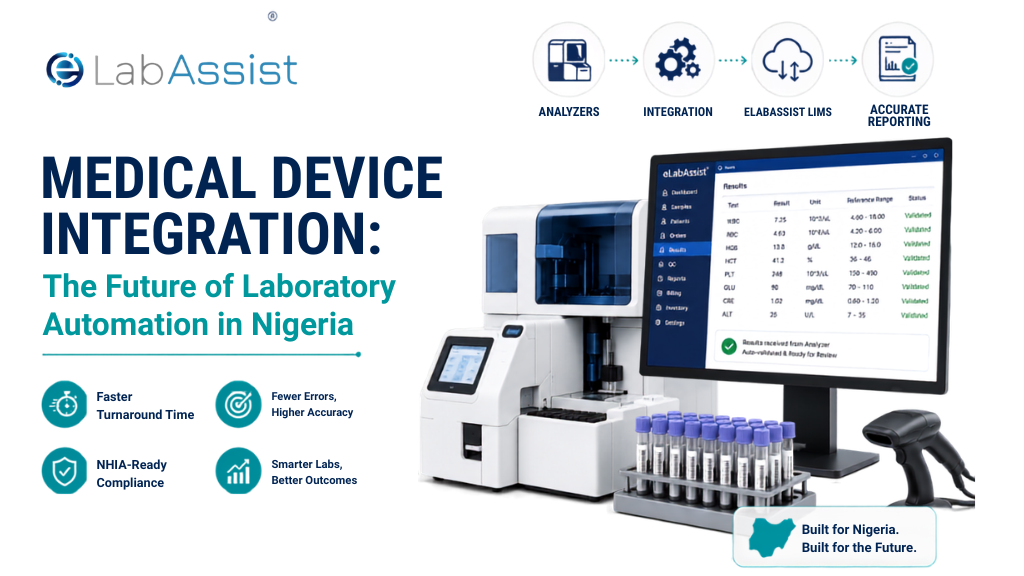
Nigeria’s diagnostics sector is growing faster than most labs’ back-office processes can keep up with. More test volume, more branches, more pressure from clinicians and patients for faster, error-free results and increasingly, more scrutiny from agencies like the National Health Insurance Authority (NHIA) around compliant, auditable reporting. In the middle of all this sits one capability that quietly decides whether a lab scales smoothly or drowns in manual work: Medical Device Integration.
Medical Device Integration, also called device interfacing or instrument connectivity, connects lab analyzers, diagnostic devices, and clinical equipment directly to a Laboratory Information Management System (LIMS) like eLabAssist, so results flow automatically from the device into the patient’s report. No retyping. No transcription errors. No bottleneck waiting for a technician to manually key in numbers from a printout.
In this article, we’ll unpack what Medical Device Integration actually means, why it’s becoming the defining feature separating modern Nigerian labs from ones still stuck on paper and spreadsheets, and what it takes to bring it into your lab with eLabAssist.
Why Medical Device Integration Matters Right Now in Nigeria
With a population of over 220 million and a fast-expanding network of hospitals and diagnostic centres, Nigeria’s healthcare system is under real pressure to modernize. Independent pathology labs in Lagos, Abuja, Port Harcourt, Ibadan, and Enugu are seeing rising test volumes from both individual patients and hospital partners, while diagnostic chains are trying to standardize quality across many branches at once.
At the same time, manual, paper-based workflows are hitting their limits. Transcription errors from typing analyzer results by hand, sample tracking gaps that increase turnaround time (TAT), and disconnected billing systems are now the biggest source of patient dissatisfaction and lost revenue not clinical mistakes. Medical Device Integration directly attacks the root of that problem: the manual handoff between a device producing a result and that result reaching a report.
What Is Medical Device Integration?
Medical Device Integration is the direct, automated connection between a lab’s diagnostic instruments hematology analyzers, biochemistry analyzers, immunoassay machines, blood gas analyzers, coagulation devices, and more and its LIMS. Instead of a technician reading a number off an analyzer’s screen or printout and typing it into the system, the result flows automatically, in real time, straight into the patient’s record.
With eLabAssist, this connection works in both directions where needed: test orders can be sent from the LIMS to the device (host query), and results are pulled back from the device into the LIMS (result interfacing) all validated against reference ranges before a technician ever sees them for sign-off.
How Medical Device Integration Works Inside eLabAssist
- Sample is barcoded and accessioned into eLabAssist, creating a unique identity for that sample from the moment it enters the lab.
- The device reads the barcode and automatically picks up the corresponding test order no manual worklist entry required.
- The instrument processes the sample and generates a raw result.
- The result is transmitted directly to eLabAssist through the device interface, without any retyping.
- Autovalidation rules and delta checks run automatically, flagging any outlier, hemolyzed sample, or value outside expected range before it reaches a report.
- The reviewing doctor or technician verifies and signs off the checked result inside eLabAssist.
- The report is generated and released ready for delivery to the patient and referring doctor, with a full audit trail logged for every step.
- The technician’s role shifts from “typing numbers” to “reviewing and approving” a much higher-value use of their time and expertise.
Manual Data Entry vs. Medical Device Integration
|
Factor |
Manual Data Entry |
Medical Device Integration |
|
Speed |
Slow depends on staff typing speed and queue |
Instant results flow the moment the device finishes |
|
Error risk |
High transcription mistakes, wrong patient, wrong value |
Low barcode-linked, no manual re-typing |
|
Staff workload |
High every result typed by hand |
Low staff focus on review and sign-off, not data entry |
|
Scalability |
Breaks down as test volume grows |
Scales smoothly across high volumes and multiple branches |
|
Turnaround time (TAT) |
Longer, especially during peak hours |
Significantly shorter |
|
Audit trail |
Manual logs, easy to lose or dispute |
Automatic, timestamped, and complete |
|
Multi-branch consistency |
Varies by staff and location |
Standardized across all connected sites |
10 Ways Medical Device Integration Powers the Future of Lab Automation in Nigeria
1. Eliminates Transcription Errors
When results move directly from diagnostic device to LIMS, there’s no manual re-typing step where a technician could enter the wrong value, decimal point, or patient ID.
2. Cuts Turnaround Time Dramatically
Removing manual entry from the workflow means results reach doctors and patients faster critical during high-throughput morning rushes when queues build up quickly.
3. Frees Skilled Staff for Higher-Value Work
Technicians spend less time typing numbers and more time reviewing flagged results, handling exceptions, and focusing on quality work that actually needs their expertise.
4. Enables Reliable Autovalidation
With clean, device-sourced data, autovalidation rules and delta checks can run confidently, catching outliers before a report is ever released.
5. Supports Multi-Branch Standardization
Labs running multiple locations across Nigeria say Lagos and Abuja get the same interfaced accuracy and speed at every branch, rather than quality depending on which technician is on shift.
6. Builds a Complete, Defensible Audit Trail
Every result, timestamp, and sign-off is logged automatically, which matters both for internal quality control and for accreditation journeys aligned with recognized quality frameworks.
7. Reduces the Cost of Human Error
Mislabeled samples, misplaced printouts, and duplicate testing caused by manual mistakes carry a real cost in wasted reagents, repeat draws, and patient trust. Medical Device Integration removes most of that risk at the source.
8. Handles High Volume Without Breaking Down
As a lab’s test volume grows, manual entry becomes the bottleneck that limits growth. Interfaced devices scale with volume instead of against it.
9. Improves NHIA and Insurance-Ready Reporting
Clean, standardized, audit-ready data makes it easier to align reporting with National Health Insurance Authority requirements and other payer expectations, reducing disputes over billing and results.
10. Prepares Labs for AI-Powered Diagnostics
Structured, device-sourced data is exactly what’s needed to layer in more advanced capabilities down the line from AI-assisted result interpretation to predictive quality analytics rather than starting from messy, manually entered records.
The Nigeria-Specific Challenges Medical Device Integration Has to Solve
Rolling out Medical Device Integration in Nigeria isn’t the same as doing it in a market with stable power and connectivity everywhere. A few realities shape how it needs to work:
1) Power reliability. Many labs pair their automation investment with inverter or solar backup so device interfacing keeps running through outages, rather than losing data mid-transmission.
2) Connectivity gaps. An offline-first architecture where data is captured locally and synced to the cloud once connectivity returns is close to essential for labs outside major urban centres, or even within them during unstable network periods.
3) Multi-branch operations. Labs with sites in different cities need centralized dashboards and role-based access so device-generated data from every branch rolls up into one consistent, comparable view.
4) Mixed legacy and modern equipment. Many labs run a combination of older analyzers and newer diagnostic instruments, so a flexible LIMS needs to interface with a wide range of device protocols rather than assuming every device is the latest model.
5) Device protocol compatibility. Different manufacturers use different communication standards (HL7, LIS-A, proprietary protocols), so integration architecture must accommodate multiple protocol layers seamlessly.
A hybrid, cloud-connected approach where critical data stays locally accessible but syncs to the cloud when possible tends to work best for Nigerian deployments, rather than a fully on-premise or fully cloud-only setup.
Who Benefits Most From Medical Device Integration
- High-volume diagnostic centres in cities like Lagos, Abuja, and Port Harcourt, where morning rushes create queues that manual entry simply can’t keep up with.
- Multi-branch lab chains, where consistency of turnaround time and accuracy across every location is a competitive differentiator.
- Hospital-based laboratories, where interfaced results need to flow quickly into hospital information systems and EMR platforms for clinical decision-making.
- Labs pursuing accreditation, where a strong, automatic audit trail supports quality frameworks and reduces the manual documentation burden during assessments.
- Growing independent labs, where Medical Device Integration allows the same staff headcount to handle rising test volume without a proportional increase in errors or delays.
- Specialized testing facilities (pathology labs, reference labs), where multiple device types and high complexity demand reliable, traceable data flow.
Medical Device Integration and Compliance in Nigeria
Compliance is no longer optional for Nigerian diagnostic labs. With the Nigeria Data Protection Act (NDPA 2023) setting expectations for how patient data must be secured, and NHIA requiring reliable, auditable reporting for insurance-linked billing, labs need systems that generate accurate data by design not accuracy that depends on a technician double-checking every entry.
Medical Device Integration supports this in two direct ways: it produces standardized, device-sourced results that are far less prone to error, and it automatically creates the timestamped audit trail that regulators, insurers, and accreditation bodies increasingly expect to see. eLabAssist is built on enterprise-grade cloud infrastructure with end-to-end encryption and role-based access control, keeping interfaced data secure, backed up, and fully auditable throughout.
Moreover, Medical Device Integration ensures traceability of the entire testing lifecycle from device receipt of the order through result transmission which is increasingly required for regulatory inspections and payer audits.
Real Impact: What Nigerian Labs Notice First
Labs that move from manual entry to Medical Device Integration typically notice a few things quickly:
- Shorter queues during peak hours, since results no longer wait behind a technician’s typing speed.
- Fewer repeat draws and disputes, as mislabeling and transcription mistakes drop sharply.
- Faster doctor sign-off, since clean, validated data moves through review more smoothly.
- Measurable turnaround time gains some labs implementing interfaced, automated LIMS workflows have reported turnaround time improvements of around 30%, alongside measurable revenue growth from faster, more reliable billing cycles.
- Reduced staff fatigue, as technicians shift from repetitive data entry to more engaging quality and exception-handling roles.
- Improved device utilization, since samples move through instruments faster without manual transcription bottlenecks.
Best Practices for Rolling Out Medical Device Integration
- Audit your existing devices first to understand which analyzers can be interfaced directly and which may need a middleware layer or protocol bridge.
- Prioritize high-volume tests for interfacing first, since that’s where manual entry creates the biggest bottleneck.
- Plan for power and connectivity realities pair the rollout with backup power and, where needed, offline-first sync capability.
- Secure device connectivity with appropriate network segmentation and encryption, since medical devices on a network introduce security considerations.
- Train staff on the new workflow, shifting their focus from data entry to review, exception handling, and quality checks.
- Start with one branch or one device, prove out the workflow, then scale across other instruments and locations.
- Work with a partner experienced in the Nigerian healthcare environment, since implementation realities differ meaningfully from markets with stable infrastructure.
- Monitor autovalidation flags closely in the first weeks to fine-tune reference ranges and delta-check thresholds for your specific patient population.
- Plan for device firmware updates and protocol changes so that integration remains stable as vendors update their equipment.
The Road Ahead: Where Lab Automation in Nigeria Is Headed
Medical Device Integration is the foundation, not the finish line. Once results flow automatically and cleanly into a LIMS, labs are positioned to layer in the next wave of automation: AI-assisted result interpretation, predictive quality control analytics, deeper EMR and hospital system integration, real-time bidirectional communication with clinical workflows, and more sophisticated NHIA and insurance billing automation. None of that is realistic on top of manual, error-prone data entry it depends on the clean, structured, real-time data that Medical Device Integration provides.
For Nigeria’s diagnostics sector, the labs that build this foundation now are the ones that will be ready to adopt the next generation of tools as they arrive, rather than playing catch-up while still typing results by hand.
Frequently Asked Questions
1) Does Medical Device Integration work with older analyzers, or only new equipment? eLabAssist supports interfacing with a wide range of device protocols, including many older analyzer models, though the exact compatibility depends on the specific machine an initial equipment audit clarifies this quickly.
2) How long does it take to set up Medical Device Integration for a lab in Nigeria? Timelines vary by the number and type of devices involved, but eLabAssist’s onboarding team, experienced in Nigeria’s healthcare environment, typically brings labs live in a matter of weeks rather than months.
3) Will Medical Device Integration work reliably with unstable power or internet in some areas? Yes, when paired with an offline-first, cloud-hybrid setup and backup power data is captured locally and syncs once connectivity is restored, which is a standard consideration for Nigerian deployments.
4) Does Medical Device Integration replace the need for skilled lab technicians? No it shifts their role from manual data entry toward reviewing, validating, and approving results, which is a higher-value use of their expertise, not a replacement for it.
5) How does Medical Device Integration help with NHIA billing and compliance? By producing clean, standardized, timestamped results and audit trails automatically, it reduces disputes and supports the accurate reporting that insurance-linked billing increasingly requires.
6) What about data security when devices connect to the LIMS? Medical Device Integration incorporates enterprise-grade encryption, secure protocols, and audit logging to ensure device data remains protected. Network segmentation and role-based access controls add additional security layers.
7) Can we integrate multiple device types at once? Yes eLabAssist’s flexible architecture supports simultaneous integration of different analyzers and diagnostic devices, whether they’re from the same or different manufacturers.
Conclusion
The future of laboratory automation in Nigeria isn’t a distant concept it’s already running quietly in labs that have connected their medical devices directly to a modern LIMS. Medical Device Integration removes the slowest, most error-prone step in the entire testing process: manual data entry. In its place, it delivers faster turnaround times, cleaner audit trails, standardized quality across branches, and a foundation ready for the next generation of AI-powered diagnostics.
For Nigerian labs facing rising test volumes and growing compliance expectations, Medical Device Integration isn’t just an efficiency upgrade it’s quickly becoming the baseline for competing in a modern diagnostics market.
The labs that embrace Medical Device Integration today are positioning themselves as tomorrow’s market leaders.