
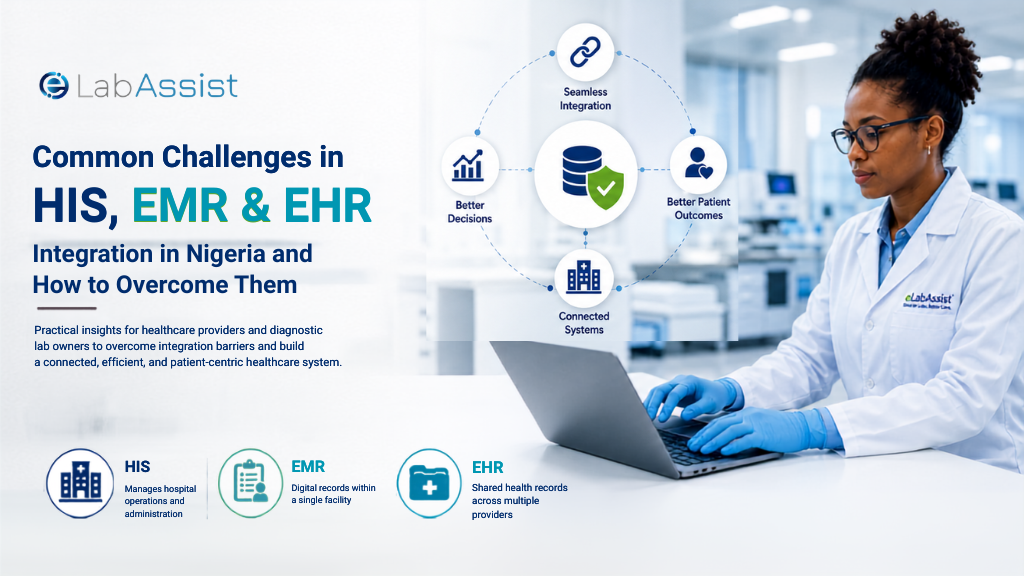
Common Challenges in HIS, EMR EHR Integration in Nigeria and How to Overcome Them
June 22, 2026
Nigeria’s healthcare system is at a crossroads. With over 220 million people, a doctor-to-patient ratio that strains even the best-resourced hospitals, and a growing network of private diagnostic labs and public tertiary facilities, the pressure to digitise and to digitise well has never been greater.
Hospital Information Systems (HIS), Electronic Medical Records (EMR), and Electronic Health Records (EHR) are no longer optional upgrades. They are the backbone of modern diagnostic care. Yet across Lagos, Abuja, Port Harcourt, and Enugu, labs and hospitals continue to grapple with fragmented data, failed integration projects, and systems that were built for foreign healthcare contexts and never truly adapted for Nigerian realities.
This blog breaks down the most common challenges in HIS, EMR, and EHR integration in Nigeria and, more importantly, the practical steps healthcare providers and diagnostic lab owners can take to overcome them.
Understanding the Difference: HIS, EMR, and EHR
Before exploring integration challenges, it helps to be clear on terminology because confusion here leads to poor procurement decisions.
Hospital Information System (HIS) manages the administrative and operational backbone of a hospital or lab: billing, patient registration, appointment scheduling, inventory, and staff management.
Electronic Medical Record (EMR) is a digital version of the patient chart within a single practice or facility. It captures clinical notes, diagnoses, prescriptions, and test results but typically stays within that facility.
Electronic Health Record (EHR) goes further. An EHR is designed to be shared across multiple providers and facilities, giving a complete longitudinal view of a patient’s health regardless of where they received care.
Integration means making these three systems and the people who use them work as one. That is where most Nigerian healthcare facilities struggle.
Challenge 1: Inadequate Digital Infrastructure
The Reality on the Ground
Nigeria’s infrastructure gaps are well-documented. Unstable electricity supply, limited broadband penetration outside major urban centres, and unreliable internet connectivity mean that cloud-based systems which power most modern EHR platforms frequently fail at the point of care. A specialist hospital in Zamfara State or a multi-branch diagnostic centre in Delta may experience power outages that interrupt live data entry, leading to data loss or reversion to paper.
Research published in Scientific Reports in 2024, assessing factors affecting EHR implementation across Nigerian healthcare facilities, confirmed that infrastructure limitations remain the single most cited barrier to successful digital health adoption.
How to Overcome It
-
Choose a system with an offline-first architecture. The best Laboratory Information Management System (LIMS) and EMR platforms built for African markets allow staff to work offline during outages and sync data automatically when connectivity is restored. This is non-negotiable for Nigerian deployments.
-
Invest in inverter and solar backup. Many labs that have successfully digitised pair their software investment with a reliable power backup system.
-
Prefer cloud-hybrid models over fully on-premise or fully cloud solutions. A hybrid setup keeps critical data locally accessible while syncing to the cloud when connected.
-
Audit your connectivity before signing a software contract. Understand what your average uptime is across branches before selecting a system with minimum connectivity requirements.
Challenge 2: Lack of Interoperability Between Systems
The Data Silo Problem
In a typical Nigerian tertiary hospital, the radiology department may run one system, the pathology lab another, the pharmacy a third, and the billing office a fourth. Each captures data in its own format, and the systems rarely speak to each other. A patient’s blood work from the lab does not automatically appear in the clinician’s EMR. Radiology reports sit in a PACS system that the referring doctor cannot access. Results are printed, carried by hand, and re-entered introducing errors and delays at every step.
This fragmentation is not unique to Nigeria, but it is more acute here because many facilities have deployed different systems at different times, often from different vendors with no integration roadmap in mind.
A 2025 review published in PLOS Digital Health on integrating digital health technologies in Nigeria’s healthcare system identified interoperability as one of the most persistent structural barriers to effective digital health delivery across the country.
How to Overcome It
-
Demand HL7 and FHIR compliance. When evaluating any HIS, EMR, or EHR vendor, ask specifically whether the system supports HL7 v2 messaging and HL7 FHIR (Fast Healthcare Interoperability Resources) APIs. These are the international standards that allow systems from different vendors to exchange data reliably.
-
Avoid vendor lock-in. Proprietary systems that cannot export data in standard formats will trap you. Insist on open APIs and data portability clauses in your contract.
-
Build an integration layer. If you have legacy systems that cannot be replaced immediately, middleware integration engines (such as Mirth Connect) can act as translators between systems.
-
Start with a unified platform where possible. Rather than stitching together five separate tools, look for a single platform that covers lab, radiology, billing, and inventory reducing the integration surface from the start.
Challenge 3: Workforce Training Deficits and Change Resistance
People Over Technology
Research from a 2025 cross-sectional study at Federal Medical Centre Gusau found that while most healthcare professionals held positive attitudes toward EMR, actual utilisation was inconsistent, with training deficits and usability concerns as primary barriers. A separate study from Ogun State in 2025 found that EMR use remained irregular across six hospitals despite deployment directly attributed to limited staff training and varying digital literacy levels.
Digital health implementations that focus exclusively on the technology and underinvest in people almost always fail. The clinician who reverts to a paper register the moment a system feels unfamiliar is not resistant to change they are responding rationally to a system that was not introduced well.
How to Overcome It
-
Build training into the implementation contract, not as an afterthought. Your vendor should provide role-specific training for lab technicians, front desk staff, billing teams, and clinicians separately, because their workflows are different.
-
Identify and invest in internal champions. Designate one or two digitally confident staff members per department as super-users. They become your first line of support and peer trainers.
-
Choose systems with intuitive, minimal-click interfaces. A lab technician handling 200 samples a day cannot afford a system with eight screens to report one result. Evaluate ease of use rigorously.
-
Plan for ongoing support. Training is not a one-time event. Refresher sessions, a responsive helpdesk, and in-app guidance features all reduce long-term user abandonment.
Challenge 4: Data Privacy and Security Concerns
A Growing Risk
As healthcare data becomes digital, the risk of breaches rises. Nigeria’s healthcare sector has not been immune to patient data held on shared drives, unencrypted emails carrying results, and systems with weak access controls are common. At the same time, Nigeria’s data protection landscape is evolving. The Nigeria Data Protection Act (NDPA) 2023 and the Nigeria Data Protection Regulation (NDPR) impose obligations on organisations handling personal data including patient health records.
A 2025 study on barriers to EHR adoption noted that 75% of healthcare workers surveyed preferred paper-based records partly due to concerns about privacy breaches in digital systems a perception problem that data security failures in other sectors have reinforced.
How to Overcome It
-
Ensure your system has role-based access control (RBAC). Not every staff member should see every patient record. The lab technician does not need access to billing data, and the billing officer should not see clinical notes.
-
Demand end-to-end encryption. Data in transit and at rest should be encrypted. Ask your vendor to specify their encryption standards.
-
Understand your NDPA obligations. If your system stores patient data in the cloud, ensure the data centre is located in Nigeria or that your vendor meets NDPA cross-border data transfer requirements.
-
Implement audit trails. Every access, edit, and deletion of a patient record should be logged automatically. This both deters misuse and provides an accountability trail.
-
Conduct staff awareness training. Many breaches are not technical — they are human. Passwords written on notepads, shared login credentials, and unsecured devices are as dangerous as software vulnerabilities.
Challenge 5: Financial Constraints and Total Cost of Ownership
Beyond the Subscription Fee
Many diagnostic labs and hospitals in Nigeria operate on tight margins. The upfront cost of an HIS, EMR, or EHR system is often quoted as the barrier but the real financial risk is the total cost of ownership: implementation fees, hardware, training, annual licences, customisation, and support contracts. When these costs are not fully understood at procurement, projects stall mid-implementation.
Additionally, the cost of poor integration duplicate tests, manual re-entry errors, delayed results, and patient dissatisfaction is rarely calculated but is often far higher than the cost of a good system.
How to Overcome It
-
Demand a full cost breakdown before signing. Implementation, training, first-year support, and annual renewal costs should all be disclosed upfront.
-
Calculate your return on investment. A well-implemented LIMS that reduces turnaround time by 30%, as achieved by DNA Diagnostics Centre with eLabAssist, and grows revenue by a measurable percentage, pays for itself faster than most facilities expect.
-
Look for modular pricing. Start with core lab management functionality and expand to radiology, inventory, and quality control modules as your budget grows rather than paying for everything at once.
-
Ask about local support infrastructure. A vendor with no local support presence in Nigeria may be cheaper, but when something breaks at 8 PM on a weekday, the true cost becomes apparent.
Challenge 6: Absence of Standardised National Policy and Regulation
The Policy Vacuum
Nigeria’s National Health ICT Strategic Framework (2016–2020) laid groundwork for digital health adoption, but implementation has been uneven. Without enforceable national standards for data formats, interoperability requirements, or minimum functionality for health IT systems, the market has filled with a wide range of products of varying quality. Hospitals and labs have no baseline against which to evaluate what they are buying.
A 2025 study published in the Global Journal of Medical Students specifically cited fragmented guidelines and limited political commitment as significant contributors to slow EHR adoption nationwide.
How to Overcome It
-
Engage with NHIA and FMOH guidelines proactively. Even where regulation is not yet mandated, aligning your systems to federal health data standards now will protect your investment when regulation arrives.
-
Favour vendors who are actively engaged with Nigerian health authorities. A technology partner with relationships with the Federal Ministry of Health, NHIA, and NAFDAC understands the regulatory direction of travel.
-
Join health IT communities. The Health Informatics Society of Nigeria (HISON) and similar bodies provide a platform to stay current on emerging standards and policy changes.
What Good Integration Looks Like in Practice
A well-integrated HIS, EMR, and EHR environment in a Nigerian diagnostic lab or hospital looks like this:
-
A patient walks in and is registered once. That registration flows automatically to the lab, radiology, billing, and the referring doctor’s portal no re-entry required.
-
A sample is collected, barcoded, and tracked through every stage of processing. The lab technician sees real-time status. The patient receives a WhatsApp notification when results are ready.
-
The clinician accesses results, previous visit history, and imaging from a single screen whether they are at the hospital or reviewing remotely on a mobile device.
-
Quality control data is captured automatically. Reports are generated for NABL accreditation without manual compilation.
-
Billing is automatically matched to tests performed and insurance schemes processed without manual reconciliation.
This is not a vision for 2030. It is what labs operating with properly integrated platforms are achieving in Nigeria today.
Choosing the Right Integration Partner
The technology is only as good as the partner who implements it. When evaluating vendors for HIS, EMR, and EHR integration in Nigeria, ask the following questions:
-
Does the system support HL7 and FHIR standards for data exchange?
-
Does it work offline, and how does it handle data sync when connectivity is restored?
-
Has it been deployed in Nigerian labs or hospitals before? Can you speak to reference customers?
-
Does it include local HMO and NHIS billing integration?
-
What does your training and ongoing support model look like and is there a local support team in Nigeria?
-
Is it NABL-ready for quality control documentation?
-
How is patient data encrypted, and where is it stored?
Conclusion
The integration of HIS, EMR, and EHR systems in Nigeria is not a technology problem alone. It is an infrastructure challenge, a workforce challenge, a policy challenge, and most fundamentally a trust challenge. Healthcare providers have been burned by systems that promised transformation and delivered frustration.
The path forward is not to avoid digital integration but to approach it with greater rigour: choosing platforms built for African realities, demanding interoperability standards, investing in people as seriously as in software, and working with partners who will still be there two years after go-live.
Nigeria’s diagnostic sector is growing. The labs and hospitals that get integration right now will set the standard for patient care, operational efficiency, and clinical accuracy for the decade ahead.