
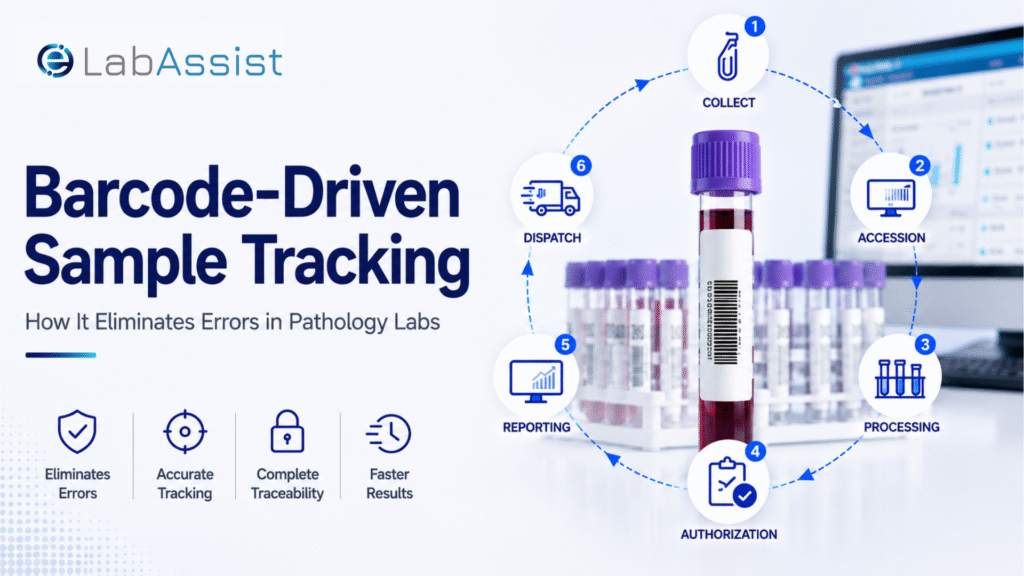
Barcode-Driven Sample Tracking: How It Eliminates Errors in Pathology Labs
May 28, 2026
The Error Problem Every Pathology Lab Has
Imagine a patient who comes in for a routine blood test. Their sample is collected, labelled by hand, placed in a rack with 30 other samples, and carried to the processing area. By the time it reaches the analyser, two labels have smudged, one sample has been placed in the wrong rack, and the register entry for three samples is incomplete. Nobody notices until a result comes back flagged as critical for the wrong patient.
This is not a hypothetical. Studies consistently show that 46-68% of all laboratory errors occur in the preanalytical phase before a single test is run and a College of American Pathologists study found that over 70% of lab-related errors arise before samples even reach the analyser. The leading causes are handwritten labelling errors, specimen misidentification, missing samples during transport, and incomplete register entries.
The human cost: A wrong diagnostic result can trigger unnecessary treatment, missed diagnoses, and in critical cases, direct patient harm. The financial cost includes repeat testing, regulatory penalties, and damaged reputation all from errors that are almost entirely preventable with the right system.
The most effective, evidence-backed solution to preanalytical errors in pathology labs is barcode-driven sample tracking a system that removes human judgment from specimen identification and replaces it with machine-verified data at every step. A meta-analysis of 17 peer-reviewed studies found that labs using barcode systems are over 4.39 times less likely to have specimen identification errors than labs using manual methods.
What Is Barcode Sample Tracking in a Pathology Lab?
Barcode sample tracking is a system where every patient specimen is assigned a machine-readable barcode label at the point of registration. As the sample moves through the diagnostic workflow from collection, to transport, to processing, to analysis, to storage each stage is logged by scanning the barcode with a handheld or fixed scanner.
The barcode is linked to the patient’s test order in the Laboratory Information Management System (LIMS). Every scan creates a timestamped record: who handled the sample, where it was, and what was done to it. This chain-of-custody record is automatic, real-time, and requires zero manual data entry after the initial registration.
The result is a complete, auditable specimen history from the moment of collection to the moment the report is signed off with no gaps, no handwriting to misread, and no opportunity for one sample to be confused with another.
Step-by-Step: How Barcode Sample Tracking Works in a Lab
Here is the complete barcode tracking workflow in a LIMS-integrated pathology lab, from the moment a patient arrives to the moment their report is released.
- Patient registration and order entry in LIMS
The patient’s demographic details and test orders are entered into the LIMS either at the front desk or via a referring physician’s digital order. The LIMS instantly generates a unique accession number and barcode for each specimen required. No manual numbering, no register writing at this stage.
Automatic barcode generation
- Barcode label printing and application before collection
The LIMS sends the barcode to the label printer at the collection station. Critically, labels are printed and applied to specimen tubes before collection begins not after. This eliminates the most common error: mislabelling a tube at the point of application when multiple patients’ samples are on the same tray. Each label includes the accession number, patient name, date, test, and tube type all machine-verified.
Scan before collection
- Sample transport and receipt scan at the lab
When a sample arrives at the laboratory whether from the same building or transported from a collection centre it is scanned on receipt. The LIMS logs the arrival time, checks the sample against the test order, and flags any discrepancy: wrong tube type, missing sample, or a sample whose expected arrival window has passed. Alerts go to the transport coordinator by SMS automatically.
Automatic delay alerts via SMS
- Pre-analytical processing centrifuge, aliquot, storage
Each processing step is barcode-logged. Before a sample enters the centrifuge, a scan logs the time. Before aliquoting, each secondary tube receives a daughter barcode linked to the parent. Before refrigeration or freezing, the storage position is recorded. If a sample is placed in the wrong centrifuge, the scan alerts the technician immediately before any damage is done to the sample.
Every step scanned and logged
- Instrument loading bidirectional LIMS interface
When the sample is loaded onto the analyser haematology, biochemistry, immunoassay, or molecular the instrument reads the barcode and queries the LIMS for the test order. The LIMS sends back the required tests. After analysis, the instrument sends results directly to the LIMS. No manual result transcription. Zero transcription errors. This bidirectional interface is where barcode tracking delivers its highest ROI in high-volume labs.
Bidirectional instrument interface
- Result validation, report release, and sample disposal
The pathologist reviews results in the LIMS all linked to the patient barcode. After validation, the report is released digitally and delivered to the patient or clinician via WhatsApp, SMS, email, or patient portal automatically triggered by the LIMS. The sample’s final status (stored, sent to reference lab, or disposed) is logged with a barcode scan, completing the full chain-of-custody record.
Auto report delivery via WhatsApp / SMS
Without Barcodes vs With Barcodes: What Changes in Your Lab
Here is an honest, side-by-side comparison of what a diagnostic lab looks like before and after implementing a barcode-driven sample tracking system integrated with LIMS.
|
Area |
❌ Manual / No Barcode |
✅ Barcode + LIMS |
|
Sample labelling |
Handwritten prone to smudging, illegibility, mislabelling |
Machine-printed, verified at point of collection |
|
Specimen identification |
Visual match by technician 1 in 500 result in ID errors (CAP) |
Barcode scan machine-verified, no visual matching |
|
Chain-of-custody |
Paper register incomplete, not real-time, easy to forge |
Digital, timestamped, tamper-evident scan log |
|
Result transcription |
Manual entry from analyser printout 0.1-1% error rate |
Bidirectional interface zero transcription errors |
|
Missing samples |
Discovered late after clinician chases for result |
Auto-alert when sample misses TAT threshold |
|
TAT monitoring |
No real-time data manager checks manually |
Live TAT dashboard per test, per technician, per workstation |
|
NABL audit preparation |
Manual compilation of register data weeks of work |
Auto-generated audit trail always current, instant export |
|
Multi-branch visibility |
No centralised view of sample status across branches |
Real-time sample status visible across all branches from one dashboard |
|
Patient safety |
Wrong-patient results possible without additional verification |
Patient ID confirmed at every scan mismatch triggers alert |
|
Error rate |
Identification errors 4.39× more likely (meta-analysis evidence) |
Labelling errors reduced up to 5-fold (AJCP 2024) |
How LIMS Barcode Integration Powers the Whole System
A barcode sticker alone does nothing. The barcode is only as powerful as the system it is connected to, and in a pathology lab, that system is the LIMS. Without LIMS integration, barcodes are merely printed numbers. With LIMS integration, each scan becomes an action: a data retrieval, a status update, a quality check, an alert trigger, or a result capture.
Here is what a fully integrated barcode LIMS system does that standalone barcode scanners cannot:
- Generates accession-linked barcodes automatically when a test is ordered no separate barcode management needed
- Sends print commands to the label printer at the correct workstation for the test type
- Validates that the barcode scanned at each stage matches the expected sample for that workstation
- Logs every scan with a timestamp, user ID, and workstation creating an immutable chain-of-custody record
- Interfaces bidirectionally with instruments sending test orders and receiving results without manual entry
- Triggers SMS or WhatsApp alerts when samples breach TAT thresholds or are scanned at the wrong station
- Auto-generates NABL-compliant audit trail reports from the scan log — exportable in PDF for accreditation audits
- Links sample tracking data to billing — so a sample that is logged as received is also automatically billed
Barcode Sample Tracking & NABL Accreditation in India
For Indian diagnostic labs pursuing NABL accreditation under ISO 15189:2022, specimen identification and chain-of-custody are non-negotiable requirements. Clause 5.4 of ISO 15189 requires labs to maintain a documented system for unique specimen identification, and Clause 5.7 requires that specimen tracking records be available for every sample from collection to disposal.
NABL assessors routinely issue non-conformances to labs that rely on paper-based registers because:
- Registers are frequently incomplete entries missed during high-volume periods
- Handwritten entries are illegible or retrospectively filled in before audits
- There is no way to verify that a register entry accurately reflects the real-time status of a sample
- Paper registers do not provide the real-time traceability that ISO 15189:2022 expects
A barcode sample tracking system integrated with a LIMS addresses all of these gaps automatically. Every sample gets a unique barcode at registration (Clause 5.4 satisfied). Every scan creates a timestamped, user-linked record in the LIMS (Clause 5.7 satisfied). The complete chain-of-custody report can be exported as a PDF for any sample in seconds during an audit.
Labs using eLabAssist LIMS with barcode tracking have consistently achieved NABL accreditation without specimen tracking non-conformances, because the audit trail is complete, current, and automatically generated not manually compiled the week before the assessor arrives.
Frequently Asked Questions About Barcode Sample Tracking
- What is barcode sample tracking in pathology labs?
Barcode sample tracking is a system where every patient specimen is assigned a unique barcode label at collection. As the sample moves through the lab from registration, to processing, to analysis, to reporting each step is logged by scanning the barcode. This creates a complete, real-time chain-of-custody record, eliminating manual data entry errors and specimen misidentification entirely.
- How much do barcode systems reduce errors in pathology labs?
A meta-analysis of 17 peer-reviewed studies found barcoding systems reduced specimen identification errors by a mean odds ratio of 4.39 meaning labs with barcoding are over 4 times less likely to have ID errors than those without. A 2024 study in the American Journal of Clinical Pathology found electronic scanning systems reduced labelling errors 5-fold compared to manual methods..
- Is barcode sample tracking required for NABL accreditation in India?
ISO 15189:2022 (the NABL standard) requires labs to maintain documented specimen identification and chain-of-custody systems under Clauses 5.4 and 5.7. While barcodes are not explicitly mandated, barcode tracking integrated with a LIMS is the accepted best practice for meeting these requirements. Labs using paper registers regularly receive non-conformances for incomplete specimen tracking during NABL assessments.
- How does barcode sample tracking integrate with LIMS software?
A LIMS with barcode integration generates unique barcodes for each test order, sends print commands to the label printer, and logs every scan as the sample moves through the lab. When a barcode is scanned at any workstation, the LIMS displays the patient details, tests ordered, expected steps, and current status and interfaces bidirectionally with analysers to send test orders and receive results without any manual entry.
- What happens in a pathology lab without barcode sample tracking?
Without barcode tracking, labs rely on handwritten labels, manual registers, and verbal communication all sources of error. Research shows 46–68% of all lab errors occur in the preanalytical phase, and over 70% of lab-related errors arise before samples reach the analyser. Common failures include wrong labelling, specimen mix-ups, missing samples, and delayed results all directly preventable with a barcode LIMS system.
Conclusion: Barcode Tracking Is Not Optional in 2026
The evidence is unambiguous. Barcode-driven sample tracking is the single most effective intervention available to diagnostic labs for reducing preanalytical errors, protecting patient safety, improving TAT, and satisfying NABL accreditation requirements. A 4.39× reduction in identification errors, a 5-fold drop in labelling errors, and complete, automated audit trails these are not incremental improvements. They are fundamental operational transformations.
For labs still operating on handwritten registers and manual labelling in 2026, the question is no longer whether to implement barcode tracking it is how quickly you can do it before the next adverse event, audit non-conformance, or patient complaint forces the issue.
eLabAssist LIMS has built-in barcode tracking supporting 1D and 2D barcode formats, bidirectional instrument interfacing, chain-of-custody logging, and real-time TAT monitoring deployable in 72 hours for labs of any size. With 1,500+ labs across India and Africa already live, the implementation process is proven, the training is straightforward, and the results are measurable from week one.